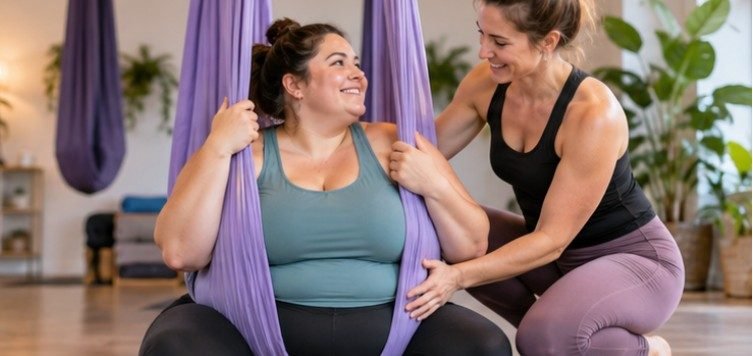
Aerial yoga can look far more intimidating than it actually is. The surprising part is that the hammock does not simply make yoga harder—it can also act as a support system, taking some load off the floor and helping beginners explore movements that may feel awkward in a traditional mat class.
That makes plus size aerial yoga for beginners less about having exceptional flexibility or upper-body strength and more about finding a properly equipped studio, a knowledgeable instructor, and movements that work for your body.
The fabric is there to assist you. You do not have to arrive ready to climb, invert, or perform circus-style tricks.
What Aerial Yoga Actually Feels Like in a Larger Body
Aerial yoga uses a wide piece of fabric suspended from secure overhead rigging. Depending on the class, you may stand beside it, sit inside it, place your hips in it, lean against it, or eventually use it for supported inversions. For a plus-size beginner, the biggest difference from floor yoga is how pressure is distributed.
Instead of relying entirely on your hands, knees, feet, and mat for support, the hammock can hold part of your body weight. That may make certain stretches and balance exercises feel more accessible.
It does not, however, make every pose automatically comfortable. Fabric pressing across the hips, thighs, abdomen, armpits, or ribs can initially feel intense. That pressure is usually different from dangerous pain, and an instructor should be able to adjust the fabric position.
A folded blanket or towel placed between the body and hammock can also make supported poses more comfortable.
Your Weight Is Only One Part of Aerial Yoga Safety
One of the most important questions beginners ask is, “Will the hammock hold me?”
Professional aerial equipment is generally designed to handle loads far above the participant’s body weight. But there is no universal safe weight number for every aerial class.
The hammock is only one component. Carabiners, attachment points, straps, ceiling anchors, structural supports, installation methods, inspection schedules, and manufacturer specifications all matter.
That means a studio’s stated participant limit is more useful than a generic internet claim that “aerial hammocks hold X pounds.”
Before booking, ask the studio directly.
| Ask the studio | A reassuring answer sounds like |
| Is there a participant weight limit? | They provide a clear limit based on their equipment and installation |
| Are beginners welcome? | They offer introductory or fundamentals classes |
| Can poses be modified? | The instructor routinely teaches variations |
| How is equipment maintained? | Rigging and fabric are inspected on a defined schedule |
| Do instructors teach larger-bodied students? | They answer comfortably and specifically rather than avoiding the question |
If a studio cannot explain its equipment limits or becomes dismissive when you ask, choose another studio.
You Do Not Need to Be Strong Before Starting
A common misconception is that aerial yoga requires enough upper-body strength to pull yourself into the air. Beginner aerial yoga should not work that way.
Introductory classes typically teach how to enter and exit the hammock while maintaining contact with the floor. The fabric can function much like a strap, wall, chair, or yoga block. Traditional yoga itself is adaptable. The National Center for Complementary and Integrative Health reports that yoga is generally considered safe for healthy people when performed appropriately with qualified instruction.
It also recommends that beginners avoid unnecessarily extreme positions and discuss modifications when health conditions are present. You therefore do not need to “get fit enough” before trying an introductory class.
Why Supported Movement Can Be Useful
Some people in larger bodies avoid exercise because previous experiences involved uncomfortable equipment, high-impact movements, joint irritation or pain, or instructors who treated every participant as though their body moved identically.
Aerial yoga provides another option rather than a universal solution.
The American College of Sports Medicine notes that combining aerobic and strength-based activity can help support joint function and muscle strength among adults with obesity who are at risk for osteoarthritis.
The Arthritis Foundation similarly recommends beginning yoga with an instructor who can observe movement and suggest modifications, particularly when someone has joint limitations.
The lesson is not that aerial yoga will “fix” joint problems. It is that adaptable, supported movement may help some people build confidence and activity tolerance.
A Five-Step First-Class Strategy

1. Choose “intro,” “fundamentals,” or “beginner”
Avoid selecting a class because the photos look exciting. Advanced aerial classes may involve drops, deep inversions, climbing, or significant grip strength. Your first session should teach the equipment itself.
2. Contact the studio before paying
Tell them you are completely new and ask whether the class and rigging accommodate your body weight. You are requesting safety information, not permission to participate.
3. Wear fitted, comfortable clothing
Leggings or fitted pants usually prevent fabric from catching loose material. A shirt that stays close to the torso can also be more comfortable during supported positions. Studios may have their own clothing rules, so check first.
4. Learn pressure before inversion
Spend time noticing how the hammock feels under your hips, back, thighs, and arms. Pressure can feel unfamiliar. Sharp pain, numbness, tingling, dizziness, or breathing difficulty is different. Stop and tell the instructor if those occur.
5. Keep your first goal deliberately small
Success does not have to mean hanging upside down. Learning how to sit securely in the hammock, perform a supported stretch, transfer weight into the fabric, and exit confidently is already a productive first class.
Federal physical-activity guidance emphasizes that inactive adults benefit from starting with small amounts of movement and building gradually. Adults ultimately benefit from a combination of aerobic and muscle-strengthening activity, but beginners do not need to achieve those targets immediately.
Modifications Are Part of the Practice

A larger abdomen may change the space available in forward folds. Weight distribution around the hips can change how fabric sits during supported poses. Shoulder mobility may affect overhead grips. None of those differences automatically mean the pose is unavailable.
A good instructor can change hammock height, widen foot placement, reposition the fabric, reduce range of motion, keep one foot grounded, add blocks, or substitute a different movement entirely.
That approach matches broader yoga practice. Harvard Health notes that beginners and people with physical limitations can use gentler forms and supportive adaptations rather than forcing the body into a standard shape.
A modification is not a failed version of a pose. It is the version designed for the person performing it.
When You Should Get Medical Advice First
Body size alone is not a reason to seek medical clearance. Certain medical circumstances may be.
Talk with a healthcare professional before participating if you have uncontrolled high blood pressure, significant balance problems, recent surgery, serious spinal problems, glaucoma, major joint injuries, or another condition that could make inversion or suspended movement unsafe. Pregnancy may also require specific modifications.
If you experience persistent dizziness, unusual shortness of breath, chest pain, sharp joint pain, or neurological symptoms during exercise, stop rather than attempting to “push through.”
Frequently Asked Questions
1. Is plus size aerial yoga for beginners safe?
It can be when equipment is appropriately rated, the installation is professional, and a qualified instructor provides beginner modifications. Always confirm the studio’s participant limits before class.
2. Do I need upper-body strength for aerial yoga?
Not for a well-designed beginner class. Early exercises can keep your feet on the floor while the hammock assists balance, stretching, and weight transfer.
3. Can the hammock hurt my hips?
Fabric pressure can feel intense, especially at first. Repositioning the hammock or adding a folded blanket may help. Sharp, numb, or persistent pain should not be ignored.
4. Do beginners have to go upside down?
No. Inversions are only one part of aerial yoga. You can develop confidence with grounded stretches, supported standing positions, seated exercises, and gentle balance work first.
A Better First Goal Than Getting Upside Down
The most useful way to approach plus size aerial yoga for beginners is to forget the dramatic poses that dominate social media. Your first class should answer simpler questions: Does the equipment feel secure? Does the instructor listen? Can you breathe comfortably, move confidently, and modify without embarrassment?
Aerial yoga should adapt to a real human body rather than require that body to match a photograph.
Find a studio that understands that distinction. Ask about the rigging, start with fundamentals, communicate whenever the fabric feels wrong, and let confidence develop before complexity. The hammock’s job is to provide support; your job is simply to learn how to use it.