The most important skill in aerial yoga is not flexibility—it is learning how to let the hammock carry part of your weight without fighting it. That changes familiar yoga movements: a forward fold can become more spacious, a squat more supported, and a resting pose can feel almost weightless.
For anyone exploring aerial yoga poses for beginners, the smartest starting point is not a dramatic inversion. It is learning how the fabric responds to your body, how to keep contact points comfortable, and how to move slowly enough to stay oriented.
Aerial yoga combines elements of traditional yoga with a suspended fabric hammock. The support can assist stretching, balance, body awareness, and strength work, but suspension also introduces unfamiliar pressure, movement, and fall risk. Beginners benefit most from mastering stable positions before attempting upside-down sequences.
Why the Hammock Changes an Ordinary Yoga Pose
On a mat, gravity constantly pulls the body toward the floor. In aerial yoga, the hammock becomes another point of support. Depending on the pose, it may hold the hips, back, legs, or upper body while the practitioner keeps some connection with the ground.
That support can make certain stretches feel more accessible because less body weight has to be controlled at once. It can also create an unstable surface, however, requiring the core and smaller stabilizing muscles to respond.
General yoga research offers useful context. The National Center for Complementary and Integrative Health reports that yoga may support balance, sleep, stress management, and general well-being. It also notes that yoga is generally considered safe for healthy people when practiced properly with qualified instruction.
The important distinction is that most research evaluates traditional yoga rather than aerial yoga specifically. Claims that aerial poses “decompress” or cure particular back conditions should therefore be treated cautiously.
7 Aerial Yoga Poses for Beginners Worth Learning First
1. Supported Standing Lean
Start by standing with the hammock behind the upper back or beneath the arms, depending on the instructor’s setup. Hold the fabric and gradually transfer a small amount of body weight backward.
The purpose is simple: learn that the hammock can support you without immediately leaving the floor. Keep both feet planted and your knees soft. Beginners who feel nervous about suspension can repeat small backward and forward weight shifts before progressing.
2. Hammock-Assisted Chair Pose
Stand facing the hammock and hold both sides securely. Bend the knees and move the hips backward as though sitting into a chair. Opt for aerial yoga poses for beginners.
Instead of struggling to maintain balance entirely on your own, use the fabric for light assistance. Your legs still work, but the hammock gives you a stable reference point. This makes the movement useful for learning the relationship between suspension, leg strength, and balance.
3. Supported Forward Fold
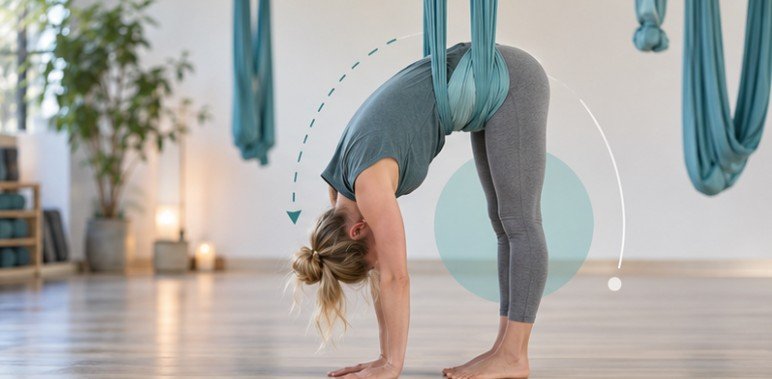
Position the fabric around the front of the hips under instructor guidance. Gradually hinge forward, allowing the hammock to take some of your weight while your torso moves toward the floor.
Keep the movement comfortable rather than forcing your hamstrings into their maximum range.
This is where many beginners first understand why aerial practice feels different from mat yoga. The hammock can support the pelvis while the spine and legs lengthen without requiring the hands to reach the floor.
4. Seated Butterfly in the Hammock
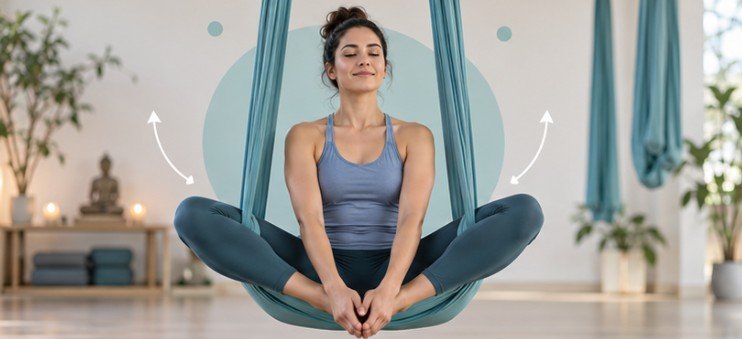
Sit securely inside the fabric. Bring the soles of the feet together and allow the knees to open outward.
Rather than trying to push the knees downward, relax and breathe. The suspended seat changes how pressure is distributed through the hips, which can make the stretch feel different from a floor-based butterfly pose.
Never bounce into a deeper stretch. Flexibility should increase gradually rather than through force.
5. Supported Backbend
With the hammock positioned correctly across the lower or middle back, gradually lean backward while keeping control of the movement.
Allow the chest to open before attempting a deeper arch. Beginners can keep their feet firmly on the floor rather than immediately allowing the entire body to hang. Slow progression matters because backbends can feel surprisingly intense when gravity and fabric support combine.
6. Aerial Downward-Facing Dog
Several beginner variations are possible. One common version places the hammock around the hips while the hands and feet remain on the floor.
The fabric removes some load from the upper body, allowing you to explore the length of the spine and the relationship between the shoulders, hips, and legs.
Think of the hammock as assistance rather than something to collapse into. Maintain active hands, shoulders, and abdominal muscles.
7. The Cocoon

Some of the most useful aerial yoga poses for beginners involve almost no athletic movement. For the cocoon, the fabric opens around the body so you can rest inside it while supported. The position is commonly used toward the end of a class for quiet breathing and relaxation.
It is also an excellent confidence exercise. A beginner learns how the fabric surrounds and supports the body without having to coordinate a complicated pose.
Which Beginner Pose Should You Try First?
Use this progression instead of choosing the most impressive-looking movement.
| Stage | Good Starting Movement | Main Skill |
| 1 | standing lean | trusting the hammock |
| 2 | assisted chair | weight transfer |
| 3 | seated butterfly | comfortable fabric positioning |
| 4 | supported forward fold | controlled suspension |
| 5 | aerial downward dog | upper-body stability |
| 6 | gentle backbend | spatial awareness |
| 7 | instructor-led inversion | upside-down control |
There is no reward for moving through these stages quickly. A beginner who can enter and leave a simple pose calmly has developed a more useful skill than someone who reaches an advanced shape but cannot control the transition.
The Three-Point Beginner Safety Check
Before every new movement, check three things: equipment, body, and exit.
Equipment
The hammock, attachment hardware, anchor point, and rigging must be designed and installed for aerial use. Home suspension should never be improvised from furniture hooks or an anchor whose load capacity is unknown.
For beginners, the hammock is commonly adjusted around hip or pelvic height, although the exact height depends on the exercise and teaching system.
Body
Ask yourself whether you feel stable, comfortable, and oriented before moving farther. General exercise-safety guidance from Johns Hopkins recommends considering health history, strength and stamina and using appropriate equipment while allowing time for warming up and cooling down.
Exit
Before entering any suspended position, know exactly how you will come out. That rule becomes especially important once both feet leave the ground. If you cannot explain the exit, wait for your instructor.
Frequently Asked Questions
1. What are the easiest aerial yoga poses for beginners?
Supported chair, seated butterfly, a gentle forward fold, standing balance yoga and standing hammock exercises, and cocoon are useful starting movements because beginners can maintain substantial support.
2. Is aerial yoga harder than regular yoga?
Not necessarily. The hammock can assist some movements but makes balance and body positioning unfamiliar. Some exercises feel easier than mat yoga, while suspended transitions may feel harder.
3. Should beginners do aerial yoga inversions?
Beginners should learn inversions only with qualified instruction after developing comfort with the hammock, controlled transitions, and safe exits.
4. How high should an aerial yoga hammock be?
Many introductory exercises use a hammock near hip height, but there is no universal setting. Height should be adjusted by the instructor according to the pose, participant, and equipment.
Build Confidence Before Chasing Height
The surprising lesson from beginner aerial yoga is that leaving the floor is not the main objective. Learning to control how much weight you give the hammock is.
Start with supported standing positions, seated stretches, folds, and restorative shapes. Once those movements feel predictable, more suspended work becomes far less intimidating. Good aerial yoga poses for beginners should build trust, control, strength, and spatial awareness—not simply produce an impressive photo. Your first goal should therefore be simple: move slowly enough that you always know where the hammock, the floor, and your body are.