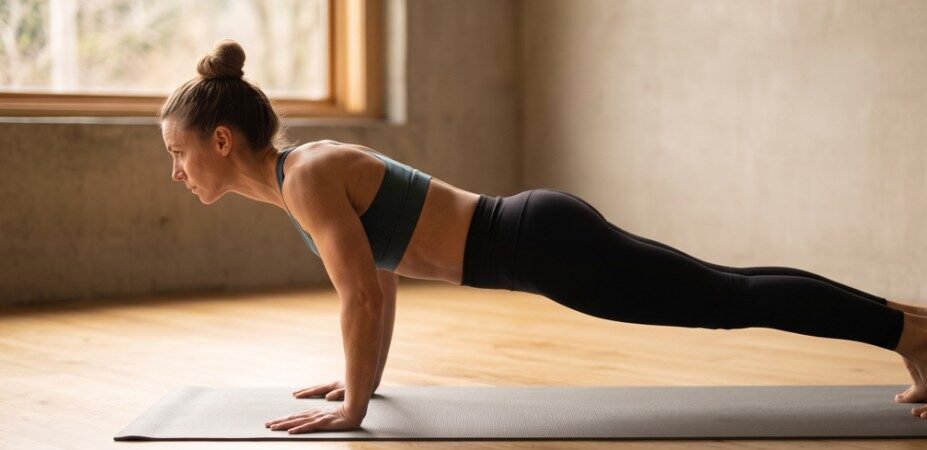
A sharp pinch in the front of your shoulder during your tenth vinyasa means your joint capsule is taking the blunt force of your body weight. Learning how to do chaturanga without shoulder pain saved my practice from chronic subacromial impingement, and it comes down to physics, not raw arm strength. If your shoulder heads dip below your elbows, your rotator cuff muscles act as emergency brakes against gravity.
Why Your Rotator Cuff Screams in Four-Limbed Staff Pose
Chaturanga Dandasana requires holding roughly 70% of your body weight in an open-chain horizontal hover. When you lower straight down from a standard plank, your forearms slant backward. This creates an aggressive anterior shear force across the glenohumeral joint. Clinical research published by the Orthopaedic Journal of Sports Medicine highlights how repetitive anterior humeral translation under load triggers impingement and chronic bursitis.
Your rotator cuff consists of four small stabilizing muscles: the supraspinatus, infraspinatus, teres minor, and subscapularis. As documented by the Cleveland Clinic, these muscles center the ball of the upper arm bone within its shallow socket. They are stabilizers, not primary movers. Forcing them to hoist your body weight because your back muscles checked out causes instant inflammation.
The Forward Shift: Fixing the Biomechanical Leverage Gap
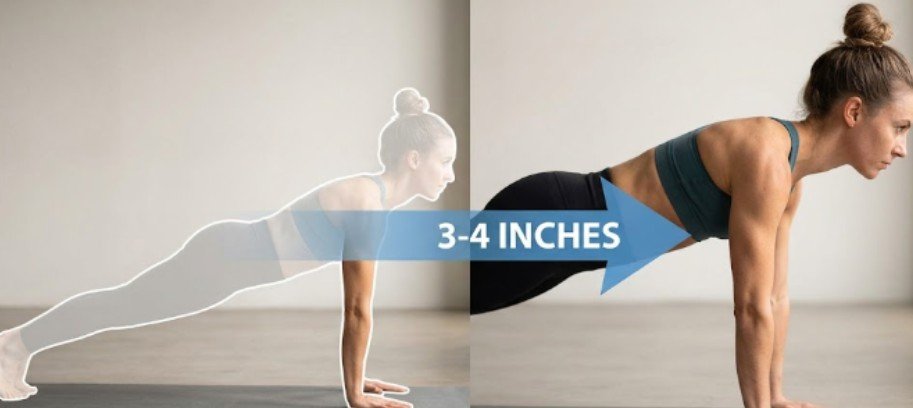
Most practitioners bend their elbows the second they decide to lower. That single mistake ruins the pose before it starts.
You must push through the balls of your feet to slide your entire body forward three to four inches. Your shoulders should hover well past your wrist creases. This shift ensures your forearms stay strictly vertical when descending, producing a sturdy perpendicular column that transfers weight straight into the skeletal frame rather than the soft tissues of the shoulder joint.
Anterior Dumping and the 90-Degree Elbow Law
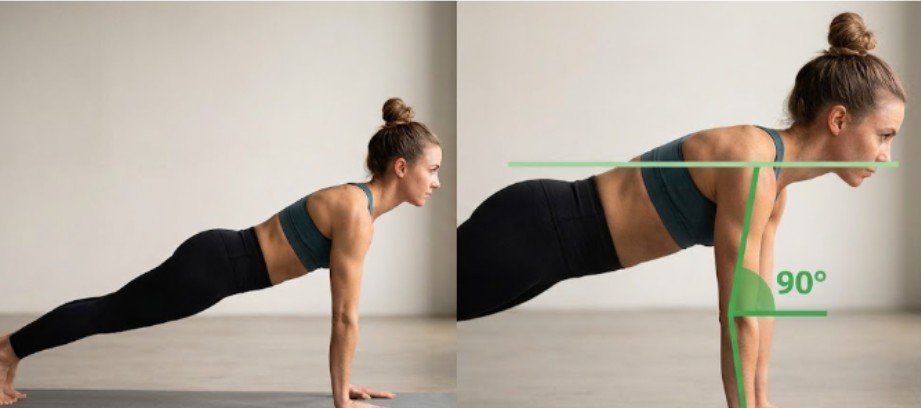
Anterior dumping occurs when the head of the humerus rolls forward and downward toward the floor. It happens most frequently when you drop lower than a 90-degree bend at the elbow.
Stopping at 90 degrees preserves joint space. Keep your shoulders at or slightly above elbow height at all times. Once the shoulder points lower than the elbow joint, gravity yanks the front of the joint capsule open, grinding tendon against bone.
Step-by-Step Execution for Zero-Pinch Chaturanga
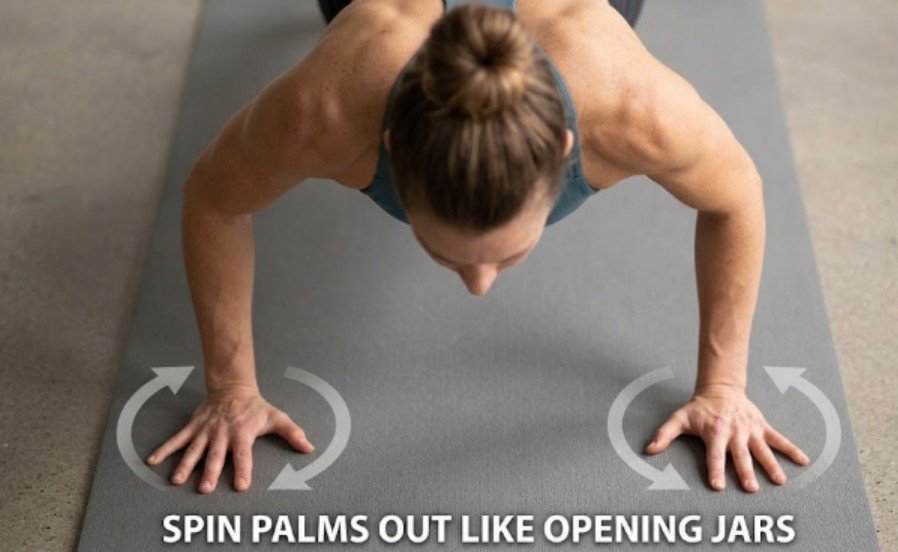
Proper form relies on total-body tension to distribute the load across multiple large muscle groups:
- Set Up the Foundation: Start in a solid high plank. Spread your fingers wide and press firmly through the base knuckles of your pointer finger and thumb.
- Shift Forward: Drive off your toes until your shoulders travel past your wrists. Keep your neck neutral and your gaze about a foot ahead of your mat.
- Engage External Torque (The Jam Jar Cue): Without moving your hands on the mat, energetically spin your palms outward as if opening two jar lids. This cues the external rotators and broadens your collarbones.
- Depress the Scapulae: Pull your shoulder blades down toward your back pockets. Engaging the lats this way prevents your upper traps from seizing up around your ears.
- Lower Halfway with Rib-Hugging Elbows: Bend your elbows straight back, grazing your ribcage as you descend. Stop the second your upper arms sit parallel to the floor.
- Press or Glide Forward: Hold the hover for one breath, then transition smoothly into Upward Dog or press straight back up into plank. If you transition from Chaturanga into Upward Dog, practicing safe backbending yoga poses for beginners can help you build the spinal mobility and control needed for a comfortable backbend.
Practicing this deliberate neuromuscular control inside a methodical hatha yoga class allows you to drill the pattern without the frantic pace of rapid flow classes.
Smart Modifications That Rebuild Scapular Strength
Dropping your ego is the fastest way to heal an angry shoulder joint. If you feel pinching, clicking, or deep ache, use these modifications to rewire your motor patterns without loading injured tissue.
A gentle morning Hatha yoga sequence can also provide a lower-intensity way to practice controlled movement and body awareness while rebuilding confidence in your form.
The Tactical Block Barrier
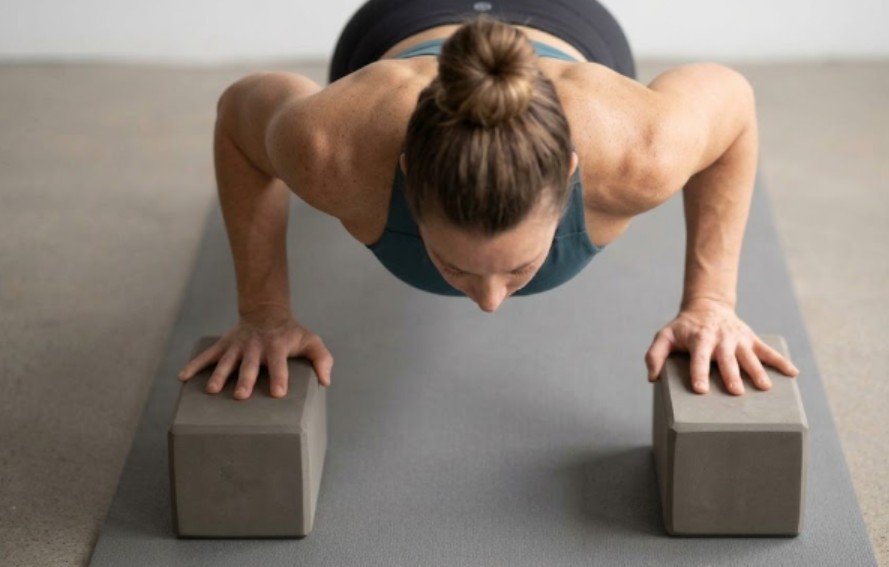
Place two foam yoga blocks at the top of your mat on their highest or medium height setting, spaced shoulder-width apart. Shift forward from plank and lower until the front tops of your shoulders lightly tap the block faces.
The blocks serve as an unyielding physical stop. They prevent you from dipping past 90 degrees while your nervous system builds muscular awareness around proper depth.
The Knees-Down Grounding Drill
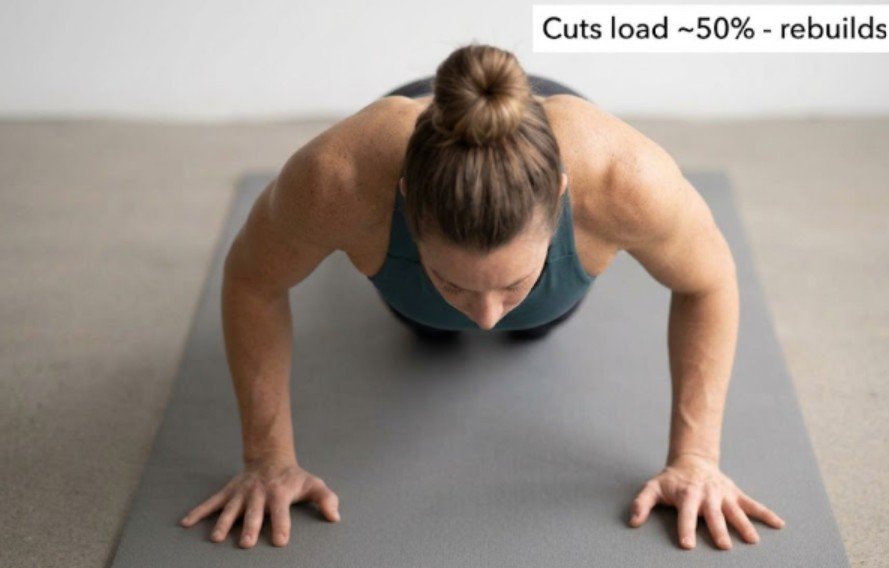
Lowering your knees to the mat cuts total lifted body weight by nearly 50%, according to scapulothoracic rehabilitation guidelines from the American Physical Therapy Association.
Keep a straight diagonal line from your knees through your pelvis up to the crown of your head. Do not allow your hips to pike backward into a tabletop position. Shift your chest forward past your wrists and lower halfway down. This builds the eccentric strength in your triceps and serratus anterior required for the full expression of the pose.
Once you have built sufficient control, you can practice the movement within a step by step sun salutation for beginners to reinforce proper Chaturanga mechanics through repeated, breath-linked transitions.
When you repeat that pattern across dozens of transitions in a vigorous sun salutation, micro-tears begin accumulating in the long head of the biceps tendon. Correct alignment redirects that load away from delicate ligaments directly into your serratus anterior, lats, and mid-back.
Frequently Asked Questions
1. Why does my shoulder click when lowering into Chaturanga?
Clicking typically indicates the biceps tendon snapping across the humeral groove due to rounded shoulders.
2. Can I skip Chaturanga if my shoulder hurts?
Yes, take a simple high plank hold, drop to low Cobra, or transition directly into Downward-Facing Dog.
3. How low should I go in Chaturanga Dandasana?
Lower only until your elbows hit a 90-degree angle, keeping your shoulders level with or higher than your elbows.
4. Does Chaturanga build chest or shoulder strength?
It primarily builds triceps, core, and serratus anterior strength while stabilizing the shoulder girdle.
Stop Cheating Your Shoulders: The Final Fix
A clean Chaturanga is an intentional isometric hover, not an uncontrolled dive-bomb toward the floor. If you feel your chest collapsing or your elbows winging outward, stop the repetition immediately. Check your forward shift, lock your shoulder blades firmly down against your back ribs, and let your core carry its fair share of the weight.