A hamstring can feel “tight” even when simply stretching harder is not the answer. Sports medicine specialists note that the sensation of stiffness does not always match an actual loss of flexibility; sometimes the nervous system is helping limit movement because of fatigue, irritation, weakness, or another problem.
That distinction makes aerial yoga poses for tight hamstrings particularly interesting. A hammock can support part of your body weight, letting you adjust a forward fold or elevated-leg stretch gradually instead of using gravity to force yourself farther.
The goal is not to get your nose to your knee or achieve a split. It is to create enough controlled tension for the back of the thigh to adapt while keeping the pelvis and spine organized.
What the Hammock Changes
Aerial stretching does not create a special biological mechanism that suddenly lengthens muscle. Its value is mechanical.
The fabric can support some of your weight, raise one leg without requiring you to hold it there entirely with muscular effort, or give you a stable contact point while you hinge at the hips.
That resembles assisted or passive stretching in some respects. The external support may make it easier to relax into a position, but it can also tempt people to go farther than their tissues are prepared for.
The American Council on Exercise also points out that perceived hamstring tightness can sometimes be connected to pelvic position and tight hip flexors. Constantly pulling harder on the hamstrings may therefore miss part of the problem.
Four Aerial Yoga Poses Worth Trying
| Pose | Hammock role | Main benefit | Keep in mind |
| Supported forward fold | Supports the pelvis | Reduces the effort needed to hold the torso | Hinge rather than rounding aggressively |
| Elevated-leg hamstring stretch | Holds one heel or ankle | Isolates one leg at a time | Keep hips facing forward |
| Aerial half forward fold | Supports hands or torso | Encourages a long spine | Bend knees if the back rounds |
| Supported split variation | Holds the front leg | Allows gradual depth control | Best after easier stretches |
1. Supported Forward Fold
Set the hammock around hip height and position the fabric securely across the front of the pelvis according to your instructor’s setup.
Begin standing rather than immediately dropping your full weight into the fabric. Slowly hinge forward from the hip joints. Keep a small bend in your knees initially and allow your torso to become heavier only as the position feels comfortable.
The useful part of this variation is not hanging as low as possible. The hammock takes some load away from the muscles that would otherwise work to support the forward fold.
Stay where you feel broad tension through the backs of the thighs rather than sharp pulling behind the knees.
2. Standing Elevated-Leg Hamstring Stretch
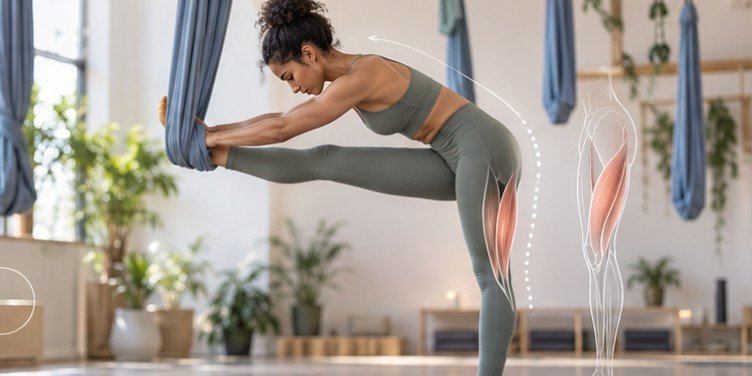
Stand facing the hammock and place one heel or lower leg into a secure loop.
Keep the standing knee unlocked. Square your hips toward the elevated foot, lengthen through your spine, and hinge forward a few degrees.
This position is similar in principle to a conventional standing hamstring stretch using a chair or bench. UC Davis Sports Medicine advises beginning stretches slowly, avoiding bouncing, and working into tightness rather than pain.
If your pelvis rotates sideways or your back rounds dramatically, lower the hammock rather than forcing the leg higher.
3. Aerial Half Forward Fold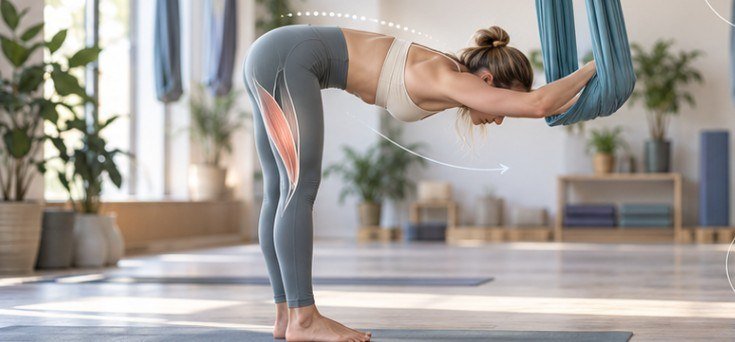
This is often a better starting option for someone whose standard forward fold immediately turns into a rounded-back toe reach.
Stand with your feet grounded and place your hands, forearms, or upper body against a low hammock, depending on the version taught in your class. Walk backward until your torso lengthens forward while your hips move behind you.
Keep your ribs drawn gently toward the body and soften the knees enough to maintain a relatively neutral spine.
The position creates hamstring tension while the hammock gives your upper body something to press or rest against.
If you are also working on lower-body control, practicing standing balance yoga poses for stability can complement flexibility work by developing the strength needed to control newly available range.
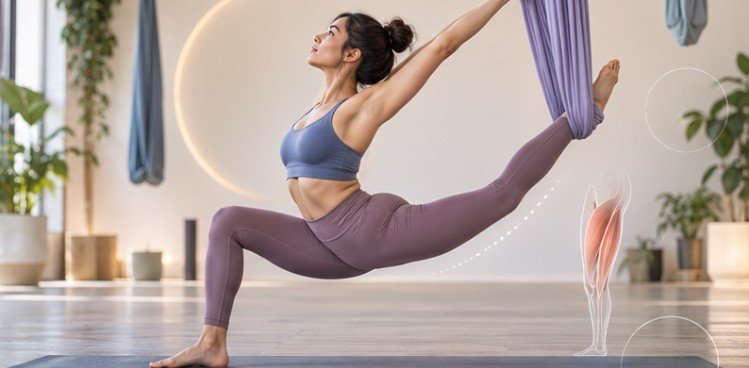
4. Supported Split or Swinging Split
Treat the split variation as a progression, not a flexibility test. With one leg supported by the hammock, gradually shift the pelvis until you notice tension through the elevated hamstring and, depending on the setup, the opposite hip flexor.
Avoid sliding rapidly into your deepest position simply because the hammock makes it possible. Mayo Clinic’s general stretching guidance recommends moving gently and typically holding a hamstring stretch around 30 seconds rather than bouncing or forcing the position.
For beginners, the elevated-leg stretch usually provides plenty of stimulus without approaching a full split.
Use the 3-Level Hamstring Test
Before choosing your pose, make a quick assessment.
First, stand comfortably and hinge forward with soft knees. Notice whether the restriction feels like ordinary tension, a strong one-sided pull, or actual pain.
Next, straighten the knees only until the sensation reaches approximately mild-to-moderate tension. If your back immediately rounds and your pelvis stops moving, you probably need a less demanding setup.
Finally, repeat the hinge after several minutes of gentle movement. If the range improves comfortably, proceed with supported stretching. If you experience sharp pain, tingling, numbness, sudden weakness, or symptoms traveling down the leg, stop rather than stretching through them. This simple check helps separate ordinary stiffness from symptoms that deserve more caution.
How Long Should You Hold Each Pose?
For most recreational practitioners, longer is not automatically better. To prevent dizziness during aerial yoga inversions.
A classic study of adults with limited hamstring flexibility found 30- and 60-second static stretches produced greater improvements than 15-second stretches over six weeks, while 60 seconds was not clearly superior to 30 seconds.
That makes roughly 20–30 seconds a practical starting range for many supported stretches. Repeat a comfortable position rather than chasing one extreme hold. Warm up first with walking, easy squats, gentle leg movements, or the early portion of your aerial class.
The Mistake That Makes Aerial Stretching Riskier
The hammock can make difficult positions feel surprisingly accessible. That is both its advantage and its limitation.
External support may let you move farther than your active strength can control. Flexibility without strength is not automatically useful mobility.
That is why aerial yoga poses for tight hamstrings should include controlled exits as well as comfortable holds. If you need momentum, a dramatic pelvic twist, or the fabric to pull you into position, reduce the range.
People recovering from hamstring strains should be especially careful. Physical therapy guidance warns that injured hamstrings should not simply be stretched immediately; rehabilitation timing depends on injury severity and healing.
Frequently Asked Questions
1. Can aerial yoga loosen very tight hamstrings?
It may help by supporting controlled stretching, but improvement comes from repeated flexibility practice over time. The hammock itself is not proven to lengthen hamstrings faster than other appropriate stretching methods.
2. Should my knees stay completely straight?
Not necessarily. A small knee bend can help you maintain better hip and spinal alignment. Gradually straighten the leg only while the stretch remains comfortable.
3. How often should I stretch my hamstrings?
Two or more sessions weekly can improve flexibility, while more consistent practice may produce better results. Avoid intense stretching if the muscle is painful or recently injured.
4. Can beginners do supported aerial splits?
Beginners can use modified split positions, but a full split is unnecessary. Start with elevated-leg and supported forward-fold variations and increase range gradually.
Give Your Hamstrings Room, Not a Fight
The most effective aerial yoga poses for tight hamstrings are rarely the most dramatic ones. A low hammock, a slightly bent knee, and a controlled hip hinge can accomplish more useful work than forcing yourself toward an Instagram-worthy split.
The research on stretching repeatedly points toward the same principle: flexibility responds to consistent, tolerable exposure. The hammock simply gives you another way to control that exposure.