
Ten quiet minutes can be easier to protect than an hour—and that may be exactly why a shorter practice survives a busy calendar. Short Yoga Nidra practices for busy lifestyles condense the most recognizable parts of the method—settling the body, rotating attention, observing the breath, and returning gradually—into a brief guided pause you can use between meetings, after a commute, or before bed.
Yoga Nidra is often translated as “yogic sleep,” but the aim is not simply to fall asleep. The practice uses guided attention while the body rests, creating deep relaxation while some awareness may remain. A 2026 systematic review of six randomized controlled trials involving 244 participants found promising improvements in sleep-related outcomes, but researchers also reported major differences among protocols and moderate-to-high risk of bias. That makes Yoga Nidra worth exploring without treating it as a guaranteed cure.
Why a Short Practice Can Still Be Useful
Full Yoga Nidra sessions often run 20 to 45 minutes or longer. A short version cannot reproduce every traditional stage in depth. Instead, it keeps the elements that fit a compressed schedule: stillness, guided body awareness, breath observation, and a deliberate return to activity.
The American Heart Association describes meditation as one way to manage stress and notes that the stress response can increase breathing rate, heart rate, and blood pressure.
A brief Yoga Nidra session may help you shift gears after a stressful call, but research does not establish that five minutes produces the same effects as a much longer protocol.
A 10-Minute Yoga Nidra Reset You Can Actually Schedule
You do not need special equipment or a perfectly silent room. The U.S. Department of Veterans Affairs currently offers iRest Yoga Nidra programs that combine breathing, visualization, body awareness, and relaxation.
UC San Diego’s Center for Mindfulness also publishes a short body-scan practice that fits into roughly 10 minutes, illustrating how structured awareness can work within a limited break. Try UC San Diego’s 10-minute body scan resource.
Minute 0–2: Make the Body Comfortable
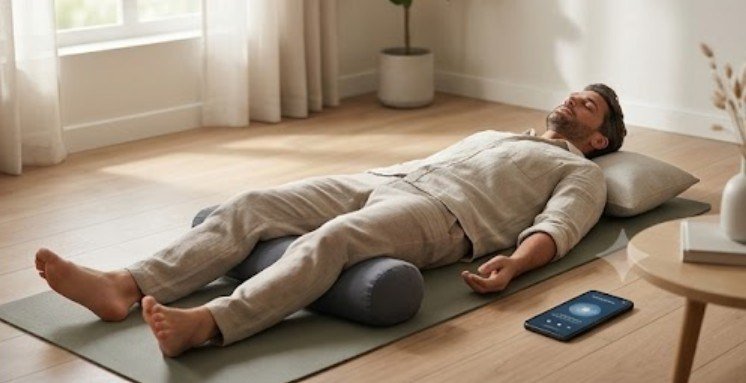
Lie on your back if you have privacy, or sit in a supportive chair with both feet on the floor. If lying down makes you too sleepy during the day, stay seated.
Take three or four easy breaths. Let the exhale lengthen naturally rather than forcing it. The goal is to reduce effort, not to “perform” relaxation perfectly.
Minute 2–6: Rotate Attention Through the Body
Move attention through specific areas: jaw, throat, right shoulder, right hand, chest, abdomen, right leg, left leg, left hand, left shoulder, face, and crown of the head.
Do not stretch, analyze, or try to remove sensations. Notice each area, then move on. This rapid rotation gives the mind a simple task while the body becomes increasingly still.
Minute 6–9: Observe the Breath
Notice breathing around the ribs, chest, or abdomen. Count several breaths backward if your mind is especially busy, or follow one inhale and one exhale at a time.
If thoughts about email, traffic, dinner, or deadlines appear, treat them as interruptions rather than failures. Return to sensation.
Minute 9–10: Re-enter Slowly
Deepen the breath slightly, notice the room, move your fingers and toes, and open your eyes. Do not practice while driving or operating equipment. VA guidance for Yoga Nidra similarly warns against combining the practice with activities that require alertness.
Match the Practice Length to the Moment
| Situation | Practical length | Main focus |
| Between meetings | 5 minutes | Body scan + natural breathing |
| Midday overload | 10 minutes | Rotation + breath awareness |
| After work | 10–15 minutes | Longer settling + body scan |
| Before sleep | 10–20 minutes | Slower pace + gentle ending |
The most useful duration is the one you can repeat. If 15 minutes keeps getting postponed, test seven minutes for a week. Regular practice makes it easier to notice whether tension, reactivity, or sleepiness actually changes.
For days when Yoga Nidra feels too structured, these short meditation routines for busy professionals offer other brief ways to create a reset during the workday.
Use Transition Points Instead of Searching for “Free Time”

A short session often works best at a transition: after closing your laptop, before an evening obligation, after exercise, or shortly before your bedtime routine.
This is more practical than waiting for a completely open hour that may never arrive. It also gives the practice a clear cue. “After my last meeting” is easier to repeat than “whenever I have time.”
If your main goal is nighttime recovery, a slower practice may suit you better than a rapid daytime reset. You can build from there with Yoga Nidra for better sleep and relaxation.
The American Psychological Association reports evidence that mindfulness meditation can help reduce stress. That does not prove every Yoga Nidra recording works equally well, but it supports the broader value of repeated attention-and-relaxation practices.
Run a Seven-Day Personal Test

Treat your routine like a small experiment. Pick one recording or sequence and use it at roughly the same time for seven days. Before each session, rate mental tension, body tension, and sleepiness from 0 to 10. Rate the same three items afterward.
At the end of the week, look for a pattern rather than one dramatic session. If body tension repeatedly falls from 7 to 4, that is useful information. If you become groggy every afternoon, shorten the practice, sit up, or move it later.
Keep expectations realistic. Yoga Nidra does not replace adequate sleep, psychotherapy, medication, or medical care. If closing your eyes or scanning the body increases discomfort or anxiety, use an eyes-open practice, stop the session, or seek trauma-sensitive guidance.
Frequently Asked Questions
1. Can five minutes of Yoga Nidra be worthwhile?
Yes. Five minutes can create a structured pause for body awareness and breathing, although research does not show that a five-minute session produces the same effects as longer protocols.
2. Is Yoga Nidra the same as taking a nap?
No. Yoga Nidra is typically guided and aims to maintain some awareness, while a nap involves actual sleep. Falling asleep during practice is still common.
3. Can I practice Yoga Nidra at work?
Yes, if you can sit or recline safely during a break. Avoid practicing while driving, operating equipment, or doing anything that requires continuous alertness.
4. How often should busy people practice?
A brief daily session is a practical starting point. If that is unrealistic, choose several repeatable time slots each week and judge the routine by whether it genuinely helps.
Make the Small Window Count
The advantage of short Yoga Nidra practices for busy lifestyles is not that ten minutes replaces sleep or erases stress. It is that a small, repeatable window can interrupt the habit of carrying one demand straight into the next.
Start with the shortest session you can practice consistently, keep the sequence simple for a week, and notice what changes afterward. If ten minutes leaves you calmer, less physically braced, or better able to transition into rest, that is enough reason to continue. A useful practice should fit your life rather than becoming another task competing for it.