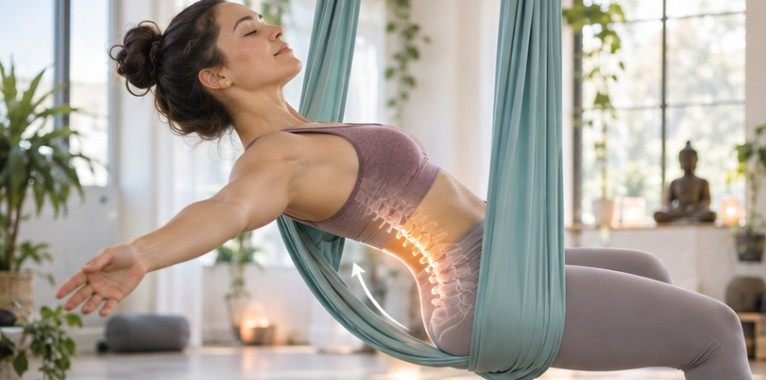
Back pain is remarkably common: CDC data found that 39% of U.S. adults reported back pain during the previous three months in 2019. Yet one of the more unusual approaches people are trying involves leaving the floor altogether.
Aerial yoga for lower back pain relief uses a fabric hammock to support part or all of the body during stretching, strengthening and, sometimes, inversion. The attraction is easy to understand. With some body weight transferred into the hammock, certain movements may feel less compressed and easier to control.
There is credible evidence that conventional yoga can modestly improve chronic low-back pain. What researchers have not yet established is that aerial yoga—or hanging upside down specifically—is superior to ordinary yoga, physical therapy or other exercise. That distinction matters before you climb into the hammock.
Why Aerial Yoga May Feel Different to a Sore Lower Back
Ordinary yoga requires you to manage your body weight against the floor. Aerial yoga changes that relationship.
A properly positioned hammock can support the pelvis, torso or legs, reducing how much muscular effort is needed to hold a stretch. This may allow someone with stiffness to explore movement without forcing the lumbar spine. Three mechanisms are particularly relevant.
Temporary Traction and Reduced Loading
During a supported back lean or partial inversion, gravity changes the forces acting through your spine. The sensation is often described as decompression or traction.
This does not mean the hammock permanently increases the space between vertebrae or repairs a damaged disc. Evidence for inversion-based traction is mixed, and any relief may be temporary.
Cleveland Clinic notes that inversion may temporarily reduce pressure through the spine but should not be considered a stand-alone treatment for back pain. Note, it is a bit difficult to do aerial yoga with wrist pain also.
That makes “decompression” a useful description of the sensation—not proof that a structural spinal problem is being corrected.
Supported Hip and Hamstring Mobility
Sometimes a painful back is doing more work because nearby joints are stiff. Tight hamstrings, restricted hips and limited thoracic movement can alter the way someone bends, sits or reaches. A hammock can support the body while those areas are moved through comfortable ranges.
The goal should not be the deepest stretch possible. It should be smoother movement without reproducing your familiar pain.
Core Control Without Heavy Loading
Aerial practice also introduces instability. The hammock moves, which means your abdominal, pelvic and spinal muscles must make small adjustments to keep you balanced. That can turn relatively simple movements into gentle core-stability work.
UCSF’s Pain Management Education program emphasizes physical therapy and strength training for chronic back pain because improving muscular mechanics and returning to activity can improve function.
For someone with back pain, controlled stability is generally more useful than dramatic aerial tricks.
What Research Actually Says About Yoga and Back Pain
The strongest evidence applies to yoga broadly rather than aerial yoga.
The National Center for Complementary and Integrative Health reviewed 21 studies involving 2,223 people and reported that yoga was slightly better than no exercise for low-back pain, with small improvements in physical function and mental quality of life. Researchers could not clearly establish that yoga was better than other forms of exercise.
The American College of Physicians also includes yoga among non-drug options that clinicians and patients may consider initially for chronic nonradicular low-back pain.
That gives aerial yoga for lower back pain relief a reasonable foundation, because it incorporates familiar yoga elements such as mobility, breathing, balance and muscular control. But the hammock itself has not been studied nearly as extensively.
A sensible expectation is therefore improved movement, confidence and exercise tolerance—not a guaranteed correction of discs, vertebrae or nerve compression.
Lower-Back-Friendly Aerial Movements to Explore
A beginner class for back discomfort should look very different from an aerial performance class.
| Movement | Potential purpose | Beginner approach |
| Supported cat-cow | Gentle spinal mobility | Keep the range small and slow |
| Hammock-supported hip hinge | Practice bending with support | Maintain comfortable spinal control |
| Supported hamstring stretch | Reduce posterior-leg stiffness | Stop before pulling becomes intense |
| Gentle back lean | Unload the torso temporarily | Keep feet grounded initially |
| Partial inversion | Brief traction sensation | Use only with instructor approval |
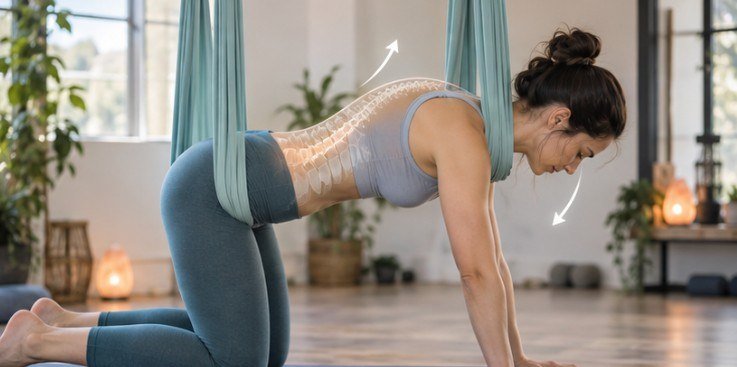
Supported Cat-Cow
With part of your body supported by the fabric, slowly alternate between gentle spinal rounding and extension. Think movement rather than stretching. Five controlled repetitions are more useful than forcing either end position.
Supported Hip Hinge
Place the hammock where your instructor recommends and practice moving backward through the hips for opening tight hips while maintaining control through your trunk. This teaches your hips to contribute to bending rather than asking the lumbar spine to provide all the movement.
Floating or Supported Back Lean
A back lean with the fabric supporting the pelvis or upper torso can produce the unloaded feeling people associate with aerial yoga.
Beginners do not need to leave the floor completely. Keeping the feet grounded provides an easy escape if symptoms change.
Inverted Butterfly and Other Full Inversions
This is where caution becomes especially important. Complete inversion may create a pronounced traction sensation, but more intensity does not automatically produce more relief. A person with an irritated nerve, acute injury or certain medical conditions may feel worse rather than better. Start with supported, upright movements before considering full inversions.
Try the 24-Hour Response Test
Pain during exercise is not the only measure that matters. How your back responds afterward is equally useful.

Before class, rate your pain and stiffness from 0 to 10. During each new movement, notice whether discomfort stays local or begins traveling into your buttock or leg.
After class, reassess yourself several hours later and again the next morning.
Mild muscle soreness may be expected after unfamiliar exercise. Increasing leg pain, new tingling, weakness or a meaningful increase in your normal back pain suggests that the exercise needs modification or medical evaluation.
Progress should be judged over multiple sessions by function: Can you walk farther, sit more comfortably, sleep better or move with less guarding?
Who Should Avoid Aerial Inversions?
Not everyone with lower-back pain should hang upside down.
Inversion changes blood pressure and increases blood flow toward the head. Cleveland Clinic recommends medical clearance for people with cardiovascular conditions, blood-pressure problems, glaucoma and several other conditions before trying inversion therapy.
Pregnancy also requires individualized exercise guidance.
More importantly, do not treat unexplained neurological symptoms with stretching. MedlinePlus advises prompt medical assessment for severe back pain associated with weakness, numbness, loss of movement or changes in bowel or bladder control.
Those are not signals to “stretch through.”
How to Choose a Back-Friendly Aerial Yoga Class

Ask the instructor whether they regularly work with beginners and whether poses can be performed without full inversion.
Tell them where your symptoms occur, what movements aggravate them and whether pain travels into your leg.
The class should allow you to control how much body weight goes into the hammock. Avoid instructors who frame pain as something to push through or promise that hanging will “put your discs back into place.”
For chronic nonspecific pain, gradual exercise is usually a better strategy than hunting for one magical stretch. The Arthritis Foundation similarly recommends modifying yoga exercises according to individual needs rather than forcing standard positions.
Frequently Asked Questions
1. Is aerial yoga good for a herniated disc?
It depends on the location and severity of the disc problem. Do not assume inversion will “fix” a herniated disc. Ask a physician or physical therapist whether aerial movements are appropriate first.
2. How often should I do aerial yoga for back pain?
Beginners may start with one supervised session weekly and judge their 24-hour response. Frequency can gradually increase if movement feels comfortable and symptoms do not worsen.
3. Can aerial yoga make lower-back pain worse?
Yes. Excessive stretching, uncontrolled inversion or movements that irritate a nerve can aggravate symptoms. Stop any pose that causes sharp, increasing or radiating pain.
4. Is aerial yoga for lower back pain relief better than regular yoga?
There is not enough research to show that aerial yoga is superior. Conventional yoga has substantially more evidence supporting modest improvements in chronic low-back pain.
The Takeaway
The most interesting benefit of aerial yoga may not be hanging upside down at all. It is the hammock’s ability to make ordinary movement feel more supported.
Used thoughtfully, the fabric can help you explore hip mobility, spinal movement and core control while gradually rebuilding confidence in movement. But aerial yoga should complement—not replace—appropriate medical care, physical therapy or other evidence-based exercise when those are needed.
Treat decompression as a temporary tool rather than a cure. Start supported, stay well inside your comfortable range, and judge success by what your back lets you do afterward. The best aerial pose is not the most impressive one; it is the one that helps you move better when your feet return to the ground.


One thought on “Aerial Yoga for Lower Back Pain Relief: Can Hanging Really Help Your Back?”