
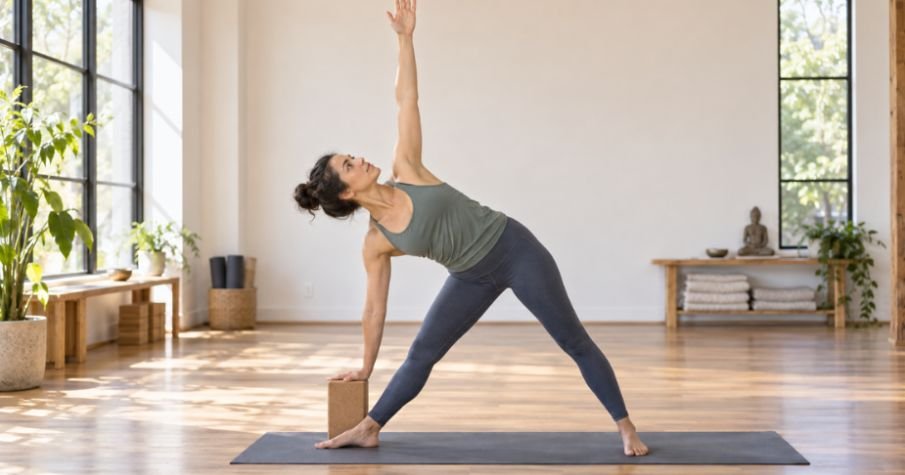
If your front knee snaps backward as you reach toward the floor, come up a little. The lowest version of Triangle Pose is rarely the one that gives you the most control. When I think about how to do triangle pose without hyperextending knees, I start with a smaller reach and an active front leg.
Triangle Pose, or Trikonasana, asks you to hold a long stance while tipping your torso over the front leg. That combination can tempt you to rest on a locked knee. You can still make a clear triangle shape while keeping the joint supported by your muscles.
Why the Front Knee Locks in Triangle Pose
Your front knee may drift backward when you shift too much weight into the front heel, take a stance you cannot control, or reach farther than your hips allow. Pressing your lower hand firmly into your shin can add pressure in the same direction.
Some people naturally have knees that extend beyond a straight line. That range alone does not tell you whether something is wrong. The useful question in this pose is whether you can choose and maintain your knee position without pain or a feeling that the joint has “caught.” Yoga Journal explains how Triangle Pose can encourage knee hyperextension.
I treat a lifted kneecap as one possible sign of thigh engagement, not as the whole instruction. For some practitioners, strongly tightening the quadriceps while pushing the knee back deepens the lock. The aim is steady muscle effort around a knee you can still control.
Set Up a Stance You Can Control
Place Your Feet and Shorten the Reach
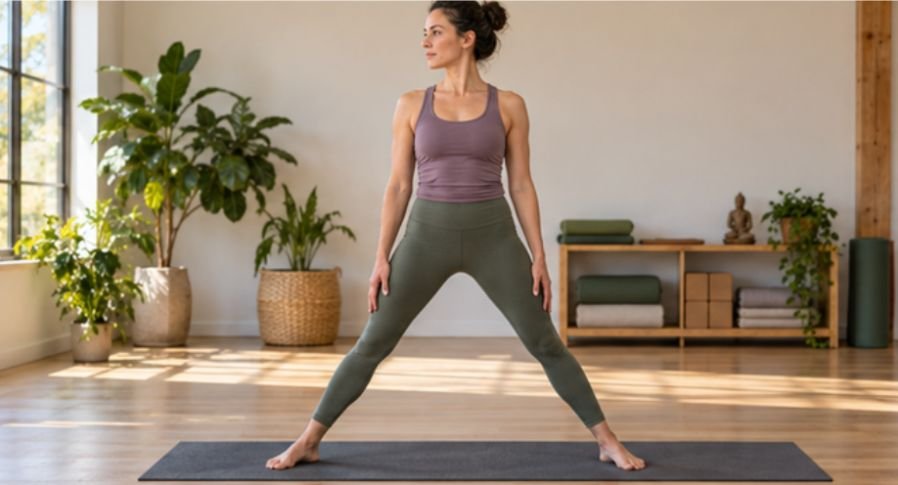
Stand facing the long edge of your mat. Step your feet apart to a width that lets you stay balanced. Turn your front toes toward the short edge of the mat and angle your back toes slightly inward. Adjust the back foot until its outer edge feels grounded.
There is no stance width that fits every body. If your front knee pushes backward as soon as you reach, bring your feet a little closer.
Building control in the legs and feet is also important when practicing standing balance yoga poses for stability, especially when learning how to maintain alignment without locking the joints.
Keep enough space to hinge at the hip without crowding yourself. Yoga International discusses how an overly wide stance can affect the front knee in Triangle Pose.
Press through the heel and ball of each foot. Give the ball of your front big toe attention if you tend to roll your weight into the heel. Keep both feet grounded rather than forcing a dramatic “mat-ripping” action; a gentle sense of drawing your feet toward each other can help you notice the legs working.
Use a Block Before You Need One
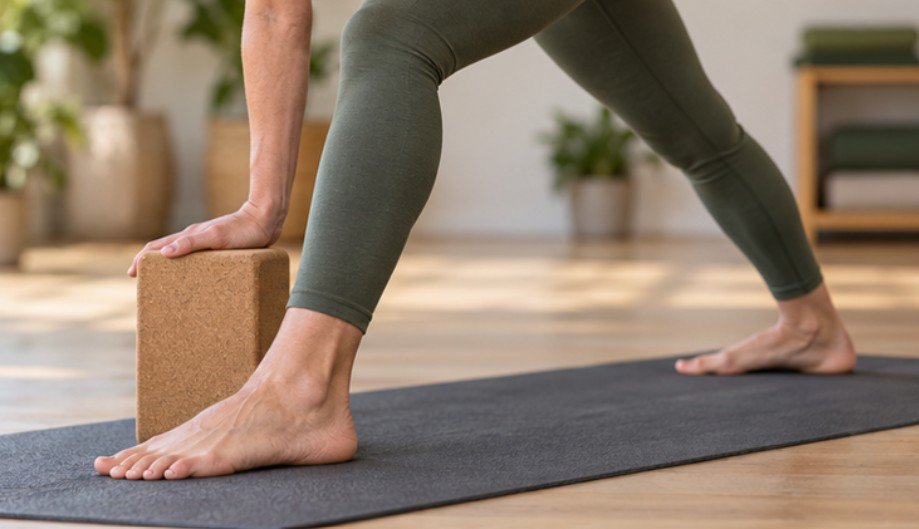
Place a yoga block outside your front ankle, within easy reach. Start at its highest setting. Your lower hand can rest lightly on it while your legs and trunk hold your weight.
I find the block most useful as a test: can I reduce the pressure of my hand without my front knee snapping back? If the answer is no, I bring my torso higher or shorten my stance. A chair seat offers more height if the block still makes me reach. Yoga International also recommends support instead of pressing into the front shin when that pressure affects knee position.
Move Into Triangle Pose Without Locking Your Knee
Bend, Engage, Then Lengthen
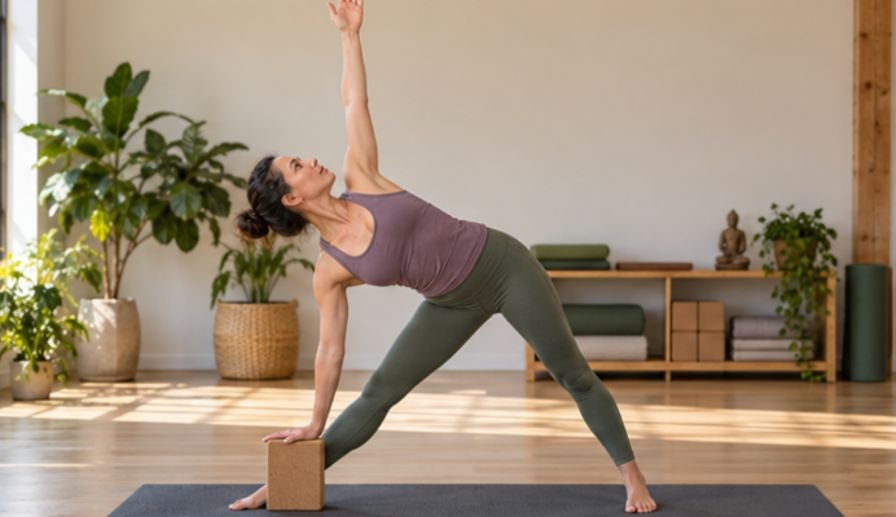
Begin with a small bend in your front knee. Feel your front foot on the floor and gently engage your thigh. Then slowly lengthen the leg until it feels strong and steady. Stop before you push the knee backward into its farthest range.
That is my bend, engage, lengthen check. It separates actively straightening the leg from letting the joint fall into its end range. You may keep a barely visible bend, especially if your knee tends to hyperextend. You do not need to turn Triangle Pose into a lunge.
Try the check once while standing upright. Then repeat it after you reach into the pose. If the second attempt sends your knee backward, your reach is too deep for the control you have right now. Raise your hand or come up slightly. The block can help, but it cannot make that adjustment for you.
Reach From the Hip, Not the Knee
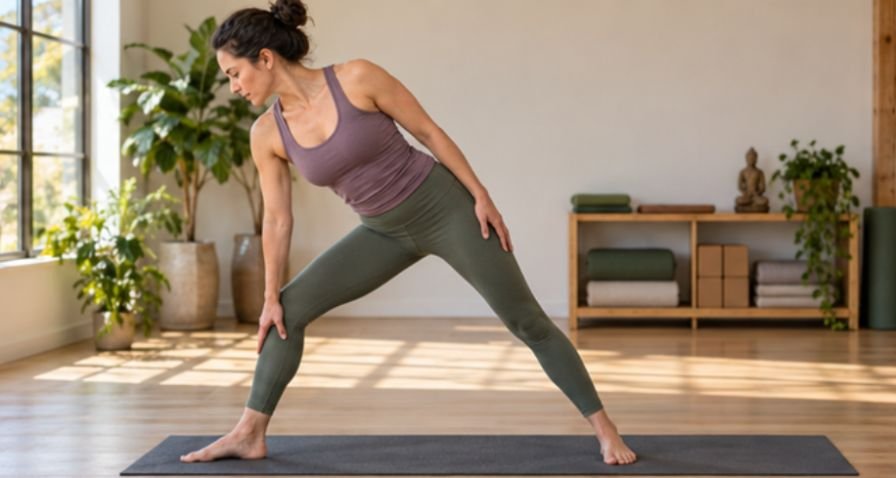
Extend both arms to your sides. Reach your front arm forward as you hinge at the front hip. Keep length along both sides of your waist. Lower your front hand onto the block, and place your top hand on your hip or extend it upward.
Avoid pulling your torso down with your lower arm. That can turn your hand into a brace and send more force through the front leg. Look straight ahead, down, or up—choose the direction that lets your neck relax and your balance stay steady.
Hold for a few easy breaths. Then press through both feet, lightly bend the front knee, and rise with control. Switch sides and set up again rather than assuming both legs need the same stance.
Check and Adjust the Pose
A mirror or a short side-view video can reveal a knee position that is hard to feel. You do not need to judge the pose by how straight it looks. Watch for a sudden backward movement as your hand descends, and notice whether you can reverse it without leaving the pose.
If you cannot, change one thing at a time: lift your hand to a higher block setting, shorten your stance, or keep a little more bend. This makes how to do triangle pose without hyperextending knees a practical question you can answer in each attempt, rather than a shape you must copy.
Tight hamstrings may also limit how far you can hinge comfortably. If you want to explore leg movement without balancing in a wide stance, a gentle seated yoga practice may be a useful companion.
For broader work on moving with control through the spine, learn safe backbending yoga. Replace these suggested paths with the matching URLs on your site before publishing.
When Knee Discomfort Calls for a Different Approach
A mild effort in your legs is different from sharp pain, pinching, instability, or swelling. Come out of the pose if you feel those symptoms. If you have a knee injury, recurring pain, or a joint condition, ask a qualified clinician or instructor for advice suited to you. The National Center for Complementary and Integrative Health notes that people with health conditions may need to modify yoga poses.
You can practice the foot placement and small knee bend while standing upright until the position feels manageable. There is no need to add the side reach on the same day.
Frequently Asked Questions
1. Should my front knee be bent in Triangle Pose?
A slight bend can help if your knee tends to lock backward. Keep it small enough that you can support the pose with your leg muscles.
2. Where should I put my hand if my knee hyperextends?
Try a block beside the front ankle or a chair seat. Rest your hand lightly instead of pressing into your shin.
3. Can I straighten my leg without locking my knee?
Yes. Slowly lengthen it from a small bend, stopping where you can hold the position with control.
4. Does knee hyperextension always mean I have injured it?
No. A knee that moves beyond straight is not, by itself, proof of injury. Pain, swelling, or instability deserves individual assessment.
Your Knee Has Nothing to Prove
I would rather hold a steady Triangle Pose with my hand on a tall block than reach the floor by hanging on my front knee. On your next attempt, set the block high, bend the knee slightly, engage the leg, and lengthen only as far as you can control. That is the part of the pose worth keeping.