If reaching toward your toes makes your back round before your legs feel anything, reaching farther will not fix the stretch. I use seated yoga poses for hamstring flexibility to find a manageable position first, then add movement only if my hips allow it.
The goal is a gentle pull along the back of the thigh. It is not to get your forehead to your knees. A chair, folded blanket, or strap can make that distinction much easier to feel.
Set up the stretch before you fold
The hamstrings run along the back of each thigh and cross both the hip and knee. That is why changing your hip position or bending your knee can change the stretch.
Before any forward fold, sit on a folded blanket if your pelvis rolls backward. Let your knees bend enough to sit tall. Then tip forward from your hip joints while keeping your chest comfortably open. You can straighten your legs gradually, but you do not need to lock your knees.
Try this quick check: Where do you feel the stretch? A mild pull behind the thigh fits the goal. A strong pull behind the knee or in the calf may ease if you stop pulling your toes toward you. Pressure in your lower back may mean you have folded past the point where your pelvis can move.
Warm muscles are usually more comfortable to stretch. A short walk or gentle movement first helps; Harvard Health suggests warming up before stretching and holding a comfortable stretch for about 30 seconds.
Four floor-seated yoga poses for tight hamstrings
Seated Forward Bend: give your spine room

For Paschimottanasana, sit with both legs in front of you. Place a folded blanket under your sitting bones if you cannot sit upright comfortably. Inhale to lengthen your torso. Exhale and tip forward from your hips, resting your hands on your legs or holding a strap around your feet.
I stop when the pull behind my thighs feels steady and I can still breathe easily. If straight knees make my lower back collapse, I bend them. The pose still works as a hamstring stretch when the movement comes from the hips.
Keep your feet relaxed or gently flexed. Pulling hard on your toes can shift your attention to your calves.
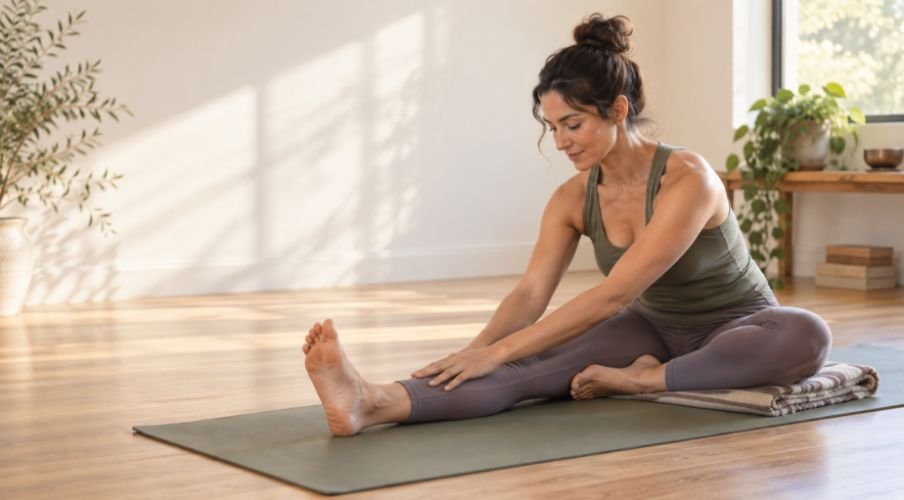
Head-to-Knee Pose: compare one leg at a time

In Janu Sirsasana, extend your right leg and bend your left knee. Place your left foot against the inside of your right leg wherever it rests comfortably. Support the bent knee with a cushion if it hangs in the air.
Turn your torso toward the extended leg, grow tall, and hinge forward. Hold your shin or use a strap. You may notice that one side needs a deeper knee bend than the other. I treat that as useful information, not a reason to pull harder.
The American Council on Exercise describes a similar seated stretch and advises moving only to tension, without bouncing or pushing into pain.
Wide-Angle Seated Forward Bend: keep the V comfortable
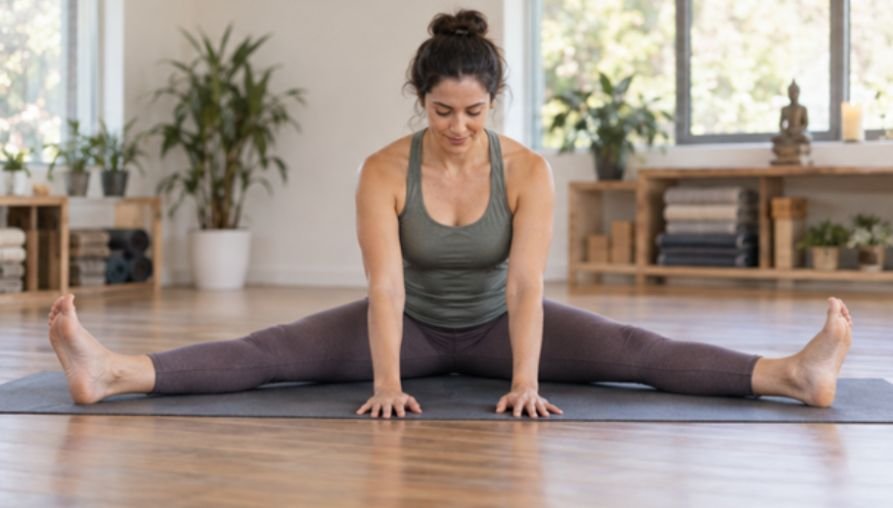
For Upavistha Konasana, open your legs into a V shape. The V does not need to be wide. Point your knees toward the ceiling, sit on a blanket if needed, and place your hands on the floor in front of you.
Walk your hands forward a little while your pelvis can still tip. This pose may stretch the inner thighs as much as the hamstrings. If you mainly feel your lower back, sit higher, narrow the V, or stay upright. ACE notes that a seated straddle can involve the inner thighs and hamstrings, so the sensation need not match a straight-leg fold. Seated Straddle with Side Reaches.
Supported Heron Pose: lift the leg without chasing height
Krounchasana, or Heron Pose, asks more of the knees and hips than the earlier poses. For a gentler version, sit on a folded blanket with your left leg bent in a comfortable cross-legged position. Bend your right knee toward your chest, loop a strap around your right foot, and lift that foot while holding the strap.
Straighten the raised leg only as far as you can without rounding your back or tugging at your knee. If the bent-leg position bothers either knee, skip this pose and choose Head-to-Knee Pose. Heron is an option for variety, not a flexibility test.
Two chair yoga options for hamstring stretching
Chair Seated Hamstring Stretch: the accessible starting point
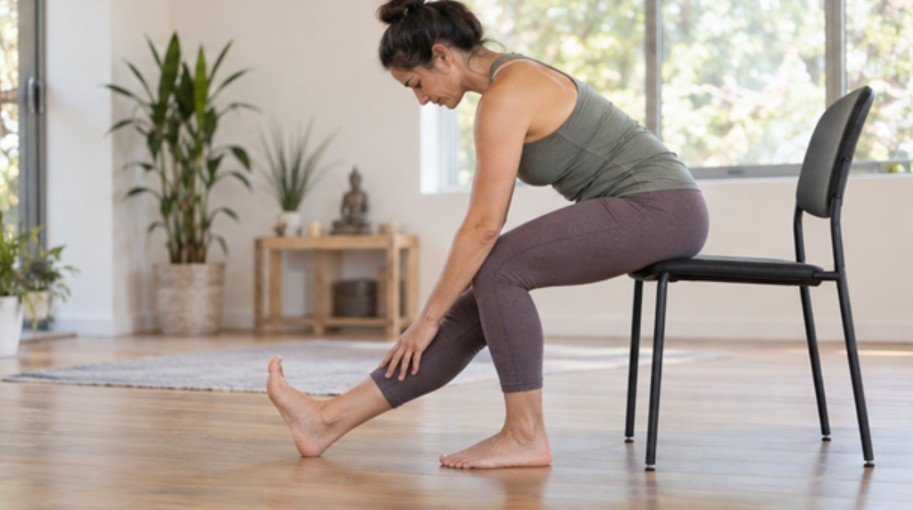
Sit near the front of a sturdy chair with both sitting bones supported. Extend your right leg, placing its heel on the floor. Keep your left foot planted. Sit tall, then tip forward a few inches from your hips.
You may feel the stretch before your torso moves much at all. Rest your hands on your hips or left thigh rather than pressing on the extended knee. Switch sides after a comfortable hold.
For this pose, a chair that stays firmly in place matters more than a deep fold. The Arthritis Foundation recommends securing a chair used as a yoga prop so it does not slip.
Chair Figure Four: stretch the hip beside the hamstrings
Sit tall and place your right ankle above your left knee. Keep your right foot active and your left foot on the floor. If the position feels comfortable, hinge forward slightly.
Here is the useful distinction: figure four mainly targets the glutes and outer hip. It does not replace an extended-leg hamstring stretch. I include it because a stiff hip can make seated folds feel awkward, and this pose lets me explore that area separately. Never push down on the raised knee.
A short seated yoga routine you can repeat
For a simple practice, start with a few minutes of walking. Sit on your chair and hold the extended-leg stretch for 20–30 seconds per side. Move to the floor for Head-to-Knee Pose, again spending 20–30 seconds on each leg. Finish with a gentle Seated Forward Bend. Breathe normally throughout.
For a more movement-focused practice, Vinyasa yoga breath to movement cueing can help connect each transition with a steady, comfortable breathing rhythm.
That sequence is a practical starting routine, not a tested formula or a promise of a specific result. Research reviews suggest stretching can improve hamstring range of motion, though results depend on how it is practiced and measured.
If you practice ashtanga or another active style, try these holds after movement, when your legs feel warm.
If you are also exploring safe-backbending-yoga, keep the same rule in mind: move within a range you can control instead of forcing a shape.
Stop if you feel sharp pain, tingling, or symptoms traveling down the leg. If you have a recent hamstring injury or persistent back or leg pain, ask a qualified clinician which stretches suit you.
Frequently asked questions
1. Which seated yoga pose is easiest for very tight hamstrings?
Start with the chair seated hamstring stretch. Keep a slight knee bend and tip forward only until you feel a gentle pull behind the thigh.
2. Should my knees stay straight in a seated forward bend?
No. Bending your knees can help your pelvis tip forward and reduce the urge to round your lower back.
3. How long should I hold a seated hamstring stretch?
Try about 20–30 comfortable seconds per side. Breathe normally, and come out of the pose if the sensation becomes painful.
4. Is chair figure four a hamstring stretch?
It mainly stretches the outer hip and glutes. Choose an extended-leg chair stretch when your main goal is the hamstrings.
Conclusion
I judge a seated stretch by how clearly I feel it in the back of my thigh, not by how close I get to my feet. Start with the chair stretch and Head-to-Knee Pose this week. Adjust your seat height and knee bend until you can hold each pose without fighting it.


One thought on “Seated Yoga Poses for Hamstring Flexibility: 6 Smart Moves”