If your lower back aches or your neck feels strained in Savasana, lying still can feel like work. When I consider how to practice savasana with proper alignment, I start with one question: Can I rest here without holding myself in place? A few small adjustments usually tell me more than trying to make the pose look perfectly symmetrical.
Savasana, or Corpse Pose, is a rest position often practiced at the end of yoga. You can also practice it on its own. The aim is to give your body steady support while allowing your muscles and attention to settle. Harvard Health describes it as a pose used to calm and center the body and mind.
Set Up Your Space Before You Lie Down
Choose a quiet spot with enough room to extend your legs and let your arms rest beside you. A yoga mat works well, but a carpeted floor can also provide support. If you get cold while resting, keep a blanket nearby.
Start seated with your knees bent and feet on the floor. Lower yourself onto your forearms, then onto your back. Move at a pace that lets you notice where your head, ribs, and pelvis land. You do not need to press every part of your spine flat.
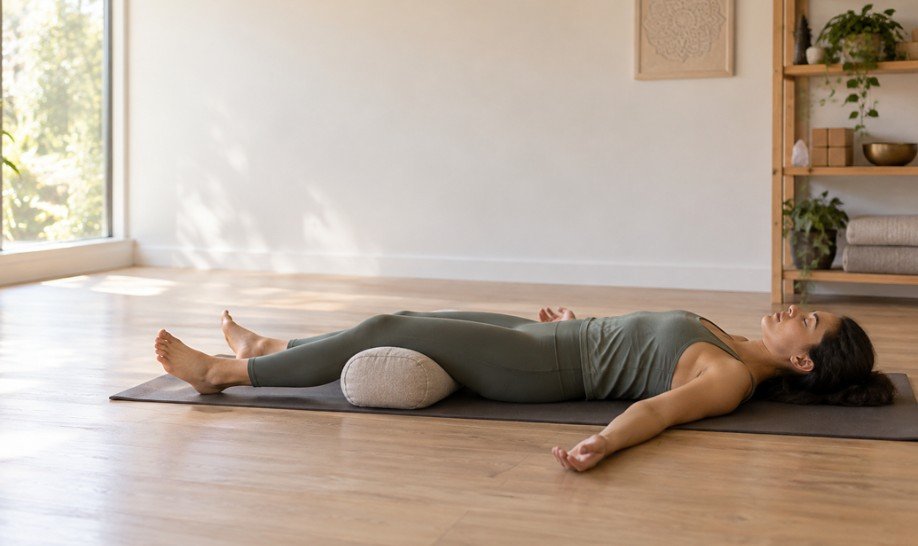
Before extending your legs, pause. If your lower back already feels uncomfortable, place a bolster or rolled blanket beneath your knees. It is easier to arrange support now than to keep shifting once you are ready to rest.
How to Align Your Body in Savasana
Settle Your Spine and Legs
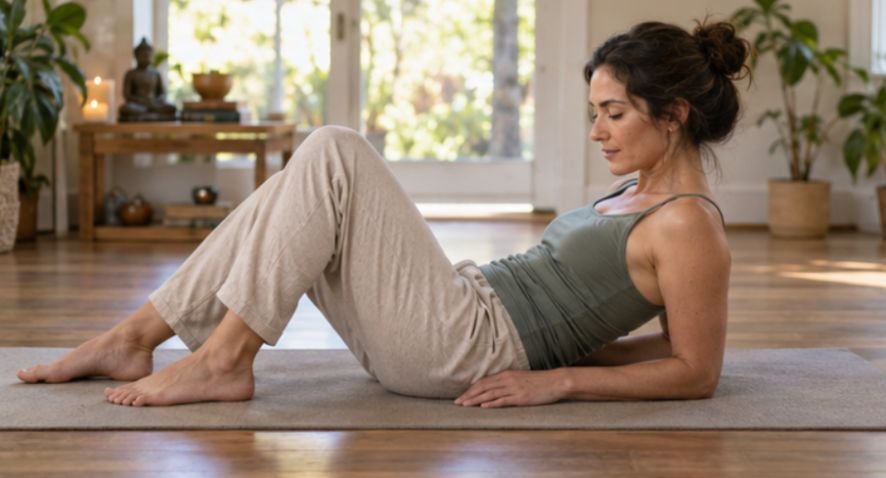
Let your pelvis rest on the floor. If it feels helpful, gently lengthen your tailbone toward your heels, then stop adjusting. Avoid forcing your lower back down. A comfortable spine may retain its natural curves.
Extend one leg, then the other. Leave enough space between your feet that your legs do not feel crowded. Relax your thighs and ankles, and let your feet turn outward on their own. There is no required 45-degree angle. If your hips feel strained, bring your legs closer together or return to bent knees.
When I check this part of the pose, I ask whether my legs feel heavy. If I am still holding my toes upright or gripping my thighs, I make one adjustment and give them time to settle.
Release Your Shoulders, Arms, and Hands
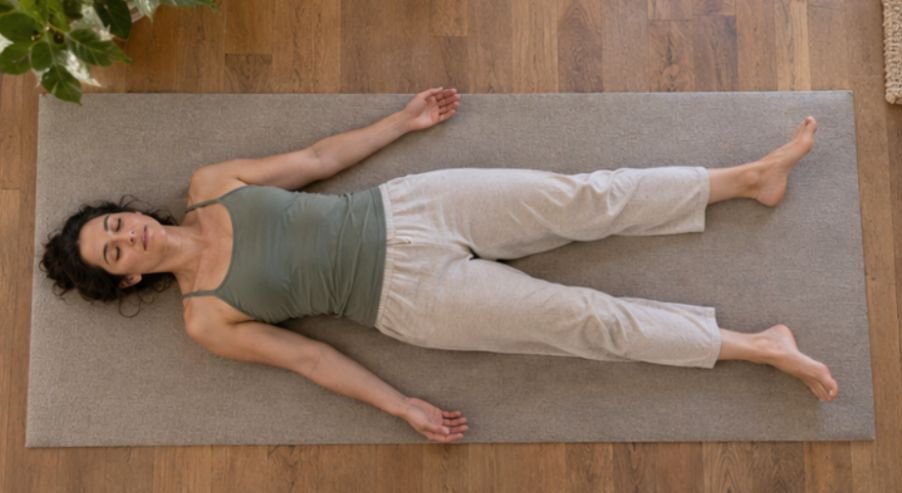
Place your arms a comfortable distance from your torso so they have room to relax. Many people like their palms facing upward, but that is optional. If turning your palms up strains your shoulders, let your hands face inward or rest them on your abdomen.
Gently broaden your collarbones without pinning your shoulder blades beneath you. Your chest should have room to breathe, with no effort needed to keep it “open.” The precise position matters less than whether your shoulders can soften against the floor.
If you enjoy detailed pose work, iyengar yoga alignment techniques can provide another way to explore support and positioning.
After active standing yoga poses, I find this shift from deliberate movement to rest especially noticeable.
Support Your Head and Neck

Let your head face the ceiling without forcing it to stay perfectly centered. Notice the angle of your chin. If it points sharply upward and the back of your neck feels compressed, try a thin folded blanket beneath your head. Keep the support low enough that it does not push your chin toward your chest.
Unclench your jaw and let your tongue rest comfortably. Close your eyes if that feels easy; otherwise, soften your gaze. You can also place an eye pillow over closed eyes if you like gentle darkness.
Use Props Where Your Body Needs Them
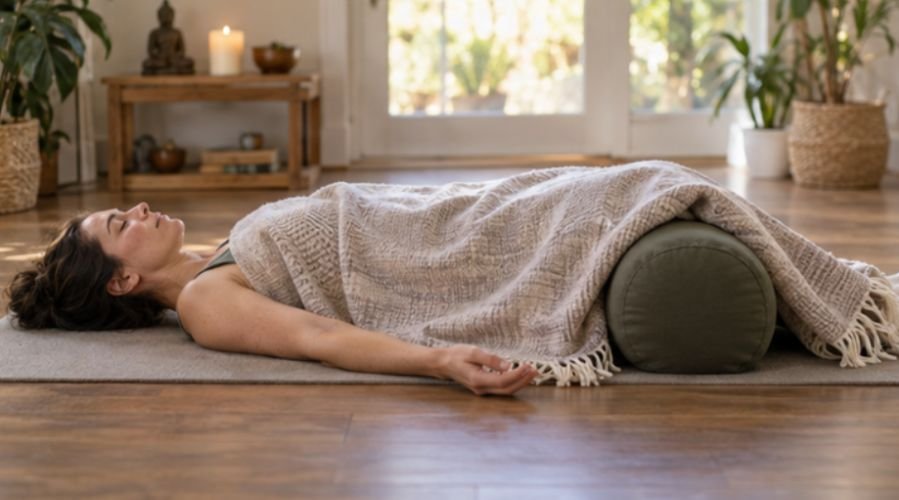
Proper alignment is a position you can maintain without effort or pain. Props help when the floor alone does not offer enough support. Cleveland Clinic notes that a bolster beneath the knees can help some people relax their lower back; Yoga Journal also suggests knee support when the back, hamstrings, or knees feel uncomfortable.
| What you notice | Adjustment to try |
| Lower back feels strained | Place a bolster or rolled blanket under your knees. |
| Chin points upward and neck feels tense | Try a thin folded blanket under your head. |
| Straight legs feel uncomfortable | Keep your knees bent or support them. |
| You feel cold or distracted | Cover yourself with a light blanket. |
Make one change at a time. Then take a few natural breaths before deciding whether it helped. This is my settle, scan, support check: settle onto the floor, scan for effort or discomfort, and support the area that needs it. It keeps me from endlessly rearranging a pose that already feels restful.
If lying on your back does not suit you, try resting on your side with support between your knees. A restful alternative serves the purpose of Savasana better than staying in a position that hurts. Yoga Journal describes side lying as an available modification.
Stay, Breathe, and Come Out Slowly
Once you feel supported, stop correcting your shape. Let your breathing follow its natural rhythm. You can notice the rise and fall of your chest or the contact between your body and the floor. If your attention wanders, return to either sensation without treating it as a mistake.
Begin with three to five minutes if a longer rest feels difficult. There is no need to force stillness. If a position causes pain, change it.
People who are pregnant or have a health condition may need individual modifications; the National Center for Complementary and Integrative Health advises discussing those needs with a healthcare professional and yoga instructor.
To finish, deepen your breath, move your fingers and toes, and bend your knees. Roll onto one side before pressing yourself up to sit. Give yourself a moment before standing.
Frequently Asked Questions
1. Should my lower back touch the floor in Savasana?
No. Your spine can keep its natural curve; use knee support if your lower back feels strained.
2. How far apart should my feet be in Corpse Pose?
Place them far enough apart that your hips and legs can relax, without forcing a set distance.
3. What should I put under my knees for Savasana?
Try a bolster, rolled blanket, or firm pillow that supports both knees comfortably.
4. How long should a beginner stay in Savasana?
Try three to five minutes, then adjust the time to suit your comfort and practice.
Let Comfort Have the Final Word
I know I have finished setting up Savasana when I no longer feel the need to hold the pose together. The best next step is simple: lie down for three minutes today, make one adjustment if something feels strained, and notice whether you can rest more easily.