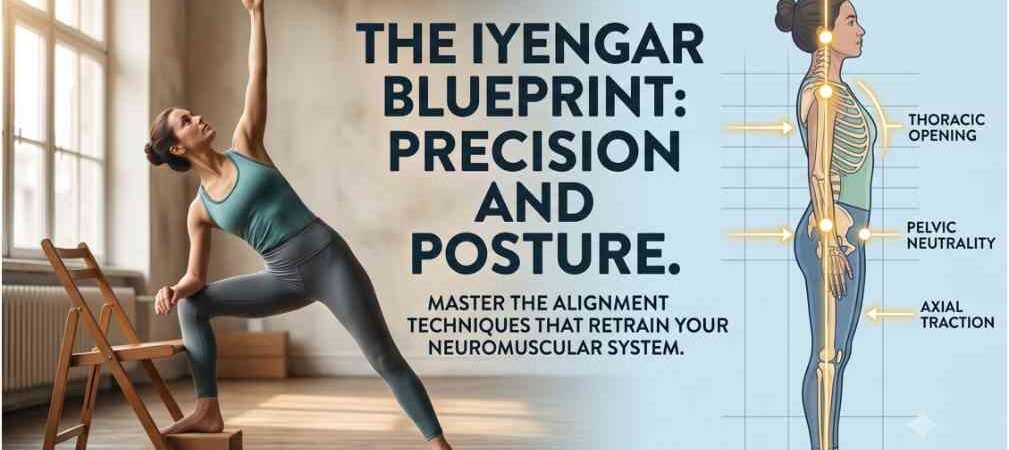
Years of slouching over drafting tables left me with chronic neck fatigue and an exaggerated anterior pelvic tilt. Standard vinyasa classes only aggravated my lower back because I was moving quickly through misalignment. Everything changed when I apprenticed under a senior teacher who taught me precise iyengar yoga alignment techniques for posture.
Iyengar yoga approaches the human body as a living architectural frame. By holding postures longer and applying external reference points like walls, blocks, and belts, we systematically recalibrate our neuromuscular system. Research indexed on PubMed confirms that static, biomechanically aligned holds improve chronic postural dysfunction by strengthening underactive postural stabilizers.
The Ground-Up Plumb Line: Calibrating Tadasana
Every postural adjustment begins in Mountain Pose. Most people treat Tadasana as a casual standing break. In Iyengar practice, it is an active, recalibrating diagnostic tool.
Calibrating the Four Foot Corners
To correct a forward-drifting center of gravity, you must anchor your base. Distribute your body weight evenly across the four corners of each foot: the ball beneath the big toe, the mound beneath the pinky toe, the inner heel, and the outer heel.
When you press those four contact points down, lift your inner ankle bones vertically. This subtle upward pull engages your arches and switches on your adductor chain. For practitioners dealing with tight groins or pelvic asymmetries, combining this grounding action with hip opening yoga restores pelvic equilibrium.
Pelvic Neutrality vs. Lumbar Pinch
A common error in posture correction is thrusting the chest out while dumping tension into the lumbar spine. Iyengar mechanics resolve this through opposing isometric actions.
- Anchor your tailbone down toward your heels.
- Draw your anterior superior iliac spines (the hip points) gently upward toward your lower ribs.
- Smooth out your lower back without flattening the natural lumbar lordosis.
According to posture studies published by Harvard Health Publishing, restoring neutral pelvic tilt eliminates shearing forces across the L4–S1 vertebrae.
Reversing Kyphosis: Biomechanical Shoulder Alignment
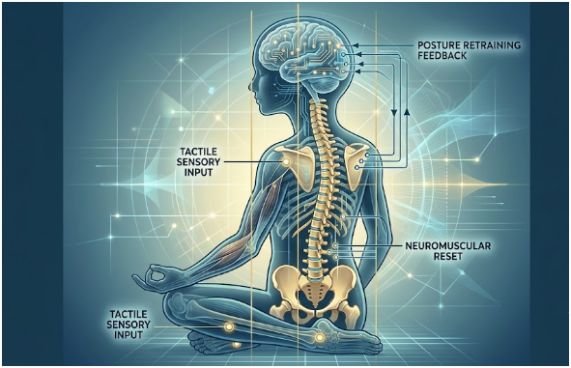
Prolonged computer use pulls the pectoralis minor into chronic shortness while overstretching the middle and lower trapezius. Iyengar yoga does not simply instruct you to pull your shoulders back. It systematically rotates the humerus to decompress the brachial plexus.
The Scapular Absorption Drill
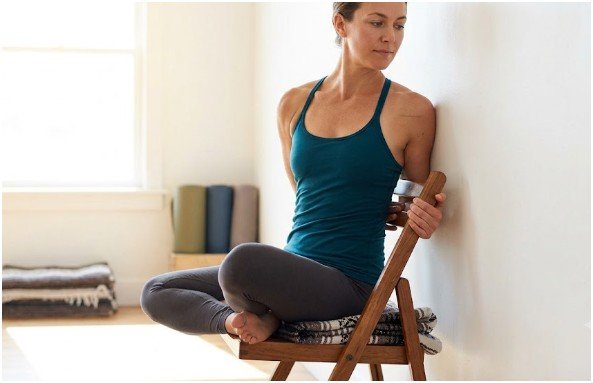
Stand with your back to an unobstructed wall. Bring your heels four inches away from the baseboard, resting your sacrum, shoulder blades, and back of the head against the flat surface.
- Roll the heads of your arm bones externally until your inner elbows face forward.
- Draw the inferior tips of your scapulae inward toward the front ribs. Senior Iyengar teachers refer to this action as “absorbing the shoulder blades into the back body.”
- Slide the trapezius muscle down away from your cervical spine, widening your collarbones laterally.
This specific manual action opens space beneath the acromion process, resolving impinging forces while retraining the upper spine. For a deep historical look at how these adjustments evolved, consult the classic literature cataloged by Yoga Journal.
Prop-Assisted Correction Matrix
Props provide objective sensory feedback. When muscle memory is warped by decades of bad posture, your brain assumes slouching is neutral. A prop reveals the distortion immediately.
| Prop | Targeted Alignment Action | Primary Postural Correction |
| Yoga Wall | Objective tactile feedback along the spinal plumb line | Eliminates forward head carriage and pelvic anterior shear |
| Cork Blocks | Scapular elevation and thoracic extension | Reverses hyperkyphosis and widens pectoral fascia |
| Cotton Belt | Isometric arm abduction at shoulder width | Stabilizes the rotator cuff and activates lower trapezius |
| Firm Bolster | Passive rib cage expansion and diaphragmatic opening | Decompresses collapsed thoracic intercostal tissues |
When executing inversions or extensions, small equipment tweaks matter. For instance, learning to use yoga blocks in downward dog takes compression out of wrists while transferring load back into the legs.
Sequence Comparison: Targeting Structural Deviations

Different posture deviations require distinct mechanical interventions. Below is a reference of how specific Iyengar postures correct common structural issues.
| Postural Issue | Recommended Pose | Structural Mechanism | Focus Cue |
| Forward Head Slump | Tadasana against Wall | Cervical retraction; activates deep neck flexors | Press occiput back while keeping chin parallel to floor |
| Thoracic Kyphosis | Supta Baddha Konasana over Bolster | Passive thoracic extension; stretches pectoralis major | Soften sternum; let arm bones drop heavy toward floor |
| Anterior Pelvic Tilt | Virabhadrasana I (heel on wall) | Psoas lengthening; posterior pelvic stabilization | Pin back heel down; draw front lower belly upward |
| Lumbar Compression | Adho Mukha Svanasana (belted hips) | Axial traction of lumbar vertebrae; hamstring elongation | Lift sitting bones high; release crown toward thumbs |
Clinical biomechanics outlined on Spine-Health demonstrate that axial spinal traction reduces intradiscal pressure, making postures like supported Downward Dog highly therapeutic for disk-related slouching.
Stop Slouching: Your Next Move
Correcting posture is not about puffing out your chest like a soldier on parade. True structural alignment is relaxed, stacked, and effortless.
Set a recurring timer at your desk every 90 minutes. Stand up, find a bare wall, and run through the Tadasana plumb-line audit for two minutes: four corners grounded, tailbone dropped, shoulder blades absorbed. Consistent micro-recalibrations rebuild posture far faster than an occasional marathon yoga session.
Frequently Asked Questions
1. How fast do Iyengar alignment techniques correct rounded shoulders?
With consistent daily practice of chest-opening prop work, noticeable postural improvements appear within four to six weeks.
2. Can beginners practice Iyengar alignment techniques safely?
Yes, because props modify every posture to match your individual skeletal range without forcing joints.
3. How often should I practice Iyengar alignment for posture?
A short 15-minute alignment check three to four times a week yields sustainable structural change.
4. What is the most important prop for posture correction?
A clear wall provides the best sensory feedback to quickly calibrate your spine’s vertical plumb line.