
The biggest obstacle to Yoga Nidra is rarely understanding the technique. It is getting yourself to lie down and practice again tomorrow. That distinction matters because Yoga Nidra for better sleep and relaxation is really two questions: how do you practice correctly, and how do you turn that practice into something your brain expects rather than something your motivation must constantly negotiate?
Research on habits offers a useful clue. Psychologist Wendy Wood’s work, highlighted by the American Psychological Association, shows that habits develop largely through repeating behaviors in stable contexts. Instead of waiting until you “feel like” practicing, consistency becomes easier when the same cue repeatedly leads to the same action. American Psychological Association on habit formation
For Yoga Nidra beginners, that means starting shorter, making the environment predictable, and lowering the threshold for showing up.
First, Understand What You Are Practicing
Yoga Nidra is usually practiced lying down while following verbal instructions that guide attention through the body, breath, sensations, imagery, or awareness. Unlike a physical yoga class, it requires little or no movement.
The U.S. Department of Veterans Affairs describes Yoga Nidra-based practices as involving deep relaxation, attention training, mindful awareness, and tools for engaging with thoughts and emotions.
Beginners sometimes assume they must reach an unusual trance-like state. That expectation can make the session harder.
Your first objective is simpler: remain comfortable enough to follow the guidance without continually evaluating whether you are “doing it right.”
If you are unsure where the practice fits alongside seated meditation, understanding how Yoga Nidra differs from traditional meditation can help you choose the right approach for your routine.
Yoga Nidra for better Sleep and Relaxation Without Overdoing It?
Begin with a session short enough that you have almost no reason to skip it.

Harvard Health recommends taking a similar approach when learning meditation: rather than immediately attempting long sessions, begin with only a few minutes and gradually extend the practice. It also suggests choosing a regular time and a space with limited distractions.
For Yoga Nidra, 10 to 15 minutes is a practical starting point. After a week or two, you can experiment with 20- or 30-minute recordings.
Longer is not automatically better. A 12-minute practice completed five times is more useful for habit building than a 45-minute session that feels so demanding you avoid doing another.
Attach the Practice to Something You Already Do
Do not simply decide, “I’ll practice tonight.”
Choose a trigger:
After brushing my teeth, I will practice Yoga Nidra.
After shutting down my work computer, I will lie down for 10 minutes.
After my morning coffee, I will practice before checking email.
A defined cue removes one decision from your day. Eventually, the existing activity begins to remind you of the new one.
Build a Space That Requires Almost No Setup
You do not need a dedicated meditation room.
Choose one repeatable location and keep the essentials nearby: a mat or bed, a light blanket, headphones if necessary, and pillows or bolsters for support.
The University of Michigan’s PainGuide recommends practicing relaxation regularly and notes that even short periods can help people learn relaxation skills. It also emphasizes finding a quiet environment and choosing techniques that people will realistically use.
Temperature is worth considering. Once you stop moving, you may become uncomfortable in a room that felt perfectly warm five minutes earlier. Keeping a blanket within reach prevents coldness from becoming an excuse to stop.
Dim lights can also reduce distraction. An eye pillow is optional, not essential.
Make Your Position Sustainable
Traditional Yoga Nidra is often practiced in Savasana, lying on your back with your arms slightly away from your torso. But comfort matters more than rigidly reproducing the textbook position.
A pillow beneath your knees can reduce strain through the lower back. You can support your head if needed or practice in a recliner. Side-lying may be preferable during pregnancy or when lying flat is uncomfortable.
NCCIH notes that yoga is generally considered safe when practiced appropriately but that individual medical conditions and circumstances can affect what is suitable. Pain is not something you need to endure to make Yoga Nidra effective.
Use the Same Recording Before Exploring More
One mistake beginners make is spending ten minutes searching for the “perfect” recording every night.
Pick one teacher or recording you find comfortable and use it repeatedly for at least a week.
Familiarity can reduce decision fatigue. You also begin recognizing the sequence—settling, body awareness, breath, intention, sensation, imagery, and returning—which makes it easier to relax into the process.
Once consistency exists, variety becomes useful rather than distracting.
If you already use gentle postures, you can also experiment with a restorative yoga and sound routine before your guided rest.
Create a Five-Minute Plan B

A consistent routine needs an emergency version.
When work runs late, your children need attention, you are traveling, or you simply feel exhausted, switch to a five-minute practice instead of canceling entirely.
Lie down, notice your breathing, slowly move awareness through major areas of the body, and finish with a brief period of stillness.
This protects the behavioral sequence even when circumstances change.
You can strengthen that ability further by learning how to bring mindfulness into your yoga practice rather than treating mindfulness as something requiring a perfect setting.
Should You Practice in the Morning or Before Bed?
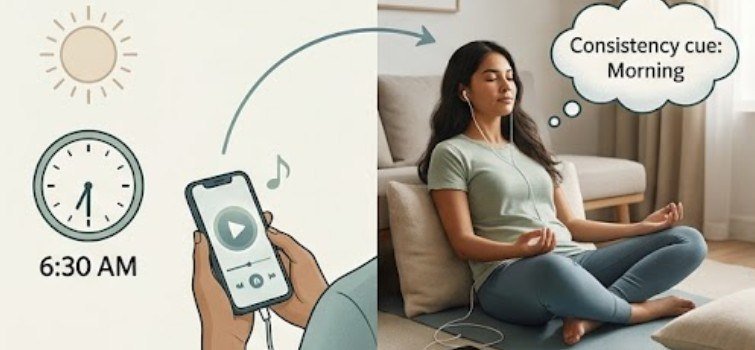
Both can work. Morning practice may suit people who frequently fall asleep during Yoga Nidra or whose evenings are unpredictable. Bedtime practice works well for people who want a structured transition away from work, screens, and mental activity.
However, do not treat Yoga Nidra as a proven cure for insomnia. NCCIH reports that yoga and relaxation approaches may support sleep quality in some populations, but the evidence for treating chronic insomnia is more limited, and cognitive behavioral therapy for insomnia has stronger guideline support. Persistent sleep problems deserve appropriate medical assessment rather than increasingly long relaxation sessions.
What If You Keep Falling Asleep?
Occasionally falling asleep is common, especially when you are tired. If your goal is learning sustained awareness, practice earlier in the day, shorten the session, or use a reclined rather than fully horizontal position.
If you remain awake but your thoughts wander, that is not failure either. Notice that your attention disappeared and return to the guide. A consistent practice is built from returning—not from maintaining perfect concentration.
Frequently Asked Questions
1. How often should a beginner practice Yoga Nidra?
Three to five sessions per week is a manageable starting point. Daily practice can work too, but consistency matters more than forcing yourself into an unrealistic schedule.
2. Yoga Nidra for better sleep and relaxation?
Choose one predictable time, begin with 5–15 minutes, use the same guided recording, prepare your space beforehand, and keep a five-minute backup practice for unusually busy days.
3. Do I need to set a Sankalpa every time?
No, but many traditional approaches include a Sankalpa, or concise intention. Beginners can use a simple present-focused intention without worrying about finding a perfect phrase.
4. Is falling asleep during Yoga Nidra bad?
Not necessarily. It often means you were tired. If developing conscious awareness is your goal, try practicing earlier, using a shorter recording, or remaining slightly more upright.
A Practice Becomes Easier When Starting It Becomes Automatic
I would not measure early Yoga Nidra progress by whether you experience extraordinary calm, stay perfectly awake, or complete long sessions. I would measure whether returning tomorrow feels slightly easier.
That is the practical answer to Yoga Nidra for better sleep and relaxation: reduce friction first. Choose a reliable cue, prepare one comfortable location, keep one trusted recording ready, and maintain a five-minute fallback option.
The depth of the practice can grow later. First, make showing up ordinary. Once lying down and pressing play stops requiring negotiation, consistency has already begun doing its work.