The hardest core exercise is not necessarily the one that makes your abs burn the most. A genuinely stable core has to resist unwanted rotation, extension, side bending, and shifting while the rest of your body moves—and instability makes that job considerably harder.
That is why aerial yoga vs TRX for core stability is an interesting comparison. Both take away some of the certainty of exercising on the floor, forcing the trunk to continuously adjust. But TRX generally creates a more direct strength challenge, while aerial yoga combines stabilization with balance, mobility, body awareness, and supported movement. Neither is simply “better.” The useful question is what kind of core stability you want to build.
What Core Stability Actually Means
Core stability exercises are broader than abdominal strength. Your abdominal wall, obliques, spinal muscles, hips, pelvis, diaphragm, and related stabilizers work together to control the trunk as your arms and legs produce movement.
The Mayo Clinic’s overview of core exercise describes the core as including the pelvis, lower back, hips, and stomach, emphasizing that coordinated core function supports balance and stability.
A good example is a plank. Your body may appear motionless, but your trunk is actively preventing the pelvis from sagging, rotating, or shifting. Add moving straps or a hammock, and those corrections become more demanding.
Research supports the broader value of core training. A 2022 systematic review and meta-analysis involving 226 participants found that core-training programs produced a moderate improvement in dynamic balance.
That matters because both aerial yoga and TRX challenge the body by introducing controlled instability.
How Aerial Yoga Trains Stability Differently
Aerial yoga uses a fabric hammock suspended from overhead. Depending on the exercise, the fabric might support the pelvis, feet, hands, back, or part of the body’s weight. The hammock is supportive, but it is not completely still.
When your center of mass shifts, the fabric moves. Your trunk then has to make small corrections to maintain position. Those adjustments recruit the muscles responsible for postural control rather than simply asking the rectus abdominis to repeatedly shorten.
The Core Challenge Comes From Control
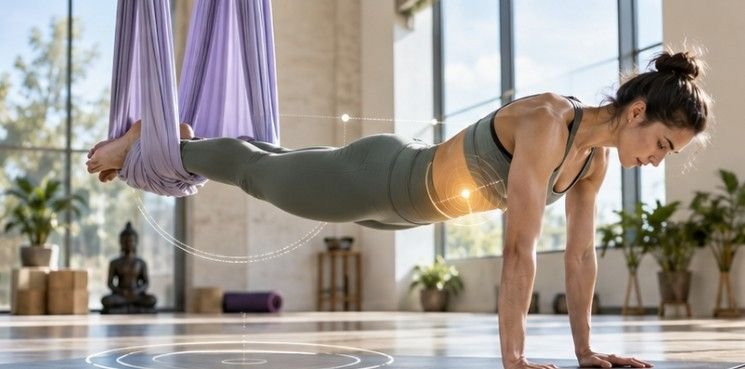
Consider a floating plank with the feet supported in fabric. If the hammock shifts slightly sideways, your trunk has to resist rotation while your shoulders and yoga for hips to open but remain aligned.
In supported balance poses, the demand changes again. The challenge may be less about producing maximum abdominal tension and more about coordinating the pelvis, spine, hips, and shoulders.
Direct high-quality research specifically measuring core activation during aerial yoga remains limited. It would therefore be misleading to claim that aerial yoga produces a particular percentage of abdominal activation based simply on research involving other suspension systems.
Evidence from conventional yoga is more established. One study examining 21 days of Hatha yoga found significant improvements in plank performance and standing balance among healthy volunteers. A newer systematic review of randomized trials also concluded that yoga appears to improve balance, although the certainty of evidence was low and protocols varied substantially.
Aerial yoga adds another instability variable to that basic yoga framework.
Why TRX Produces Such a Strong Core Demand
TRX uses two adjustable straps attached to a fixed anchor. Your hands or feet interact with the straps while gravity and body weight provide resistance. The key difference is leverage.
Move your feet farther from or closer to the anchor during many standing exercises, and you can alter the resistance without adding external weight. Raise your feet into the straps for movements such as suspended planks or knee tucks, and instability increases further.
Research on suspension trainers is considerably stronger than research specifically on aerial yoga. A systematic review covering 18 studies found moderate to very high activation of upper-body and core muscles during exercises including suspended push-ups, prone bridges, hamstring curls, and related movements. Suspension versions frequently generated greater activation than their traditional equivalents, although results varied considerably between exercises.
Another study found that TRX-style suspension planking produced greater rectus abdominis activation than a conventional prone plank or Swiss-ball plank, although the same advantage was not observed equally in the external obliques and erector spinae.
Researchers examining rollouts, body saws, pikes, and knee tucks also found especially high activation during suspension rollouts and body saws.
The American Council on Exercise’s suspension-training guidance demonstrates how suspension workouts can incorporate rollouts, knee tucks, rows, presses, and lower-body movements into one routine.
A Simple Test to Decide Which Fits You
Instead of choosing by appearance, start with your main training problem.

Choose Aerial Yoga If You Struggle With Body Awareness and Mobility
Aerial yoga makes sense if your goal is to combine core control with flexibility, balance, and movement exploration.
It can also provide support during positions that might otherwise be difficult on the floor. The hammock may allow you to explore an exercise while distributing part of your body weight, although the amount of assistance varies dramatically with the pose.
Someone who enjoys yoga but wants an additional balance challenge may therefore find aerial work more engaging than a conventional strength circuit.
Choose TRX If You Want Measurable Strength Progression
TRX has an advantage when progression matters. You can make the same movement easier or harder by altering body angle, stance, range of motion, foot position, or exercise variation. That makes progression relatively straightforward.
If you can comfortably perform a supported standing press, for example, you can gradually increase your lean. A plank may progress into knee tucks, body saws, or rollouts.
That structure makes TRX particularly useful for people interested in functional strength alongside core stability.
Use Both If Your Goals Overlap
There is no physiological reason your training has to become an either-or contest.
A person might use TRX twice weekly for progressive strength work and attend aerial yoga for mobility, balance, and movement variety. U.S. physical activity guidance recommends muscle-strengthening activity on at least two days per week for adults, so either format can contribute to a broader program when appropriately challenging. See the Physical Activity Guidelines for Americans for the wider recommendations.
More Instability Is Not Automatically Better
One common mistake is assuming that greater wobbling always means superior core training. It does not.
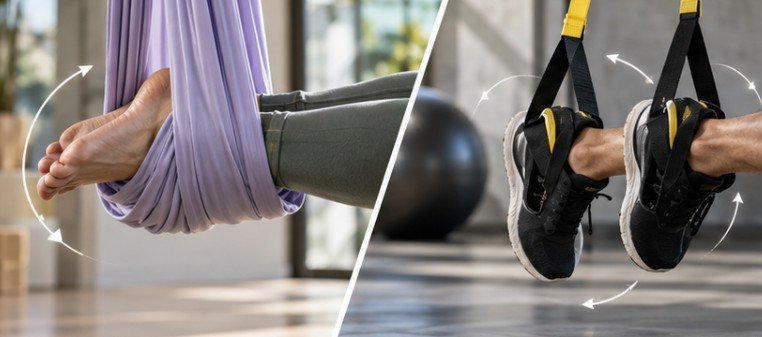
One study comparing floor and suspension versions of push-ups, bridges, and planks found that patterns of core-muscle co-contraction were not universally greater during suspension exercise. The authors cautioned that perturbations created by suspension training may sometimes be excessive for inexperienced or injured participants.
A systematic review also found that instability can reduce maximum strength, power, and movement-speed performance under certain conditions. The goal is therefore controlled instability—not surviving increasingly chaotic exercises.
For beginners, I would prioritize maintaining a neutral trunk, breathing normally, and controlling the straps or hammock before increasing difficulty.
The Harvard Health guidance on core training similarly recommends beginning with manageable exercises and progressing once a full set can be performed comfortably. Try listening to music during yoga for a more restorative experience.
Anyone with back problems, osteoporosis, significant balance difficulties, recent surgery, or other medical concerns should discuss unfamiliar exercise with a healthcare professional. Mayo Clinic’s core-strength guidance specifically advises people with certain health concerns to seek professional guidance before beginning core exercise.
Frequently Asked Questions
1. Is TRX better than aerial yoga for abdominal strength?
TRX generally provides easier-to-progress resistance and has stronger research showing substantial abdominal activation. Aerial yoga can still challenge the core, especially through balance and stabilization.
2. Can beginners use aerial yoga for core stability?
Yes, provided the class is beginner-appropriate and professionally supervised. Supported poses can reduce some loading, but unfamiliar suspension and aerial yoga inversion benefits require careful instruction.
3. Does TRX work the deep core muscles?
Suspension exercises can activate abdominal and trunk stabilizers strongly, although activation varies by exercise. Planks, rollouts, body saws, and knee-tuck variations can be particularly demanding.
4. How often should I train my core?
Two or three focused sessions per week can suit many healthy adults, depending on workout intensity and recovery. Core training can also be incorporated into full-body strength sessions.
The Takeaway
For aerial yoga vs TRX for core stability, the biggest difference is not whether your core works—it is what your core is being asked to control.
TRX provides a clearer pathway toward progressive resistance, anti-rotation strength, and demanding plank-based movements. Aerial yoga places stability inside a broader practice involving balance, flexibility, spatial awareness, and supported positions.
If measurable strength is the priority, TRX offers the more straightforward progression system. If you want core control blended with mobility and balance, aerial yoga has a different kind of value. Whichever you choose, quality wins: the most productive instability is the amount you can control with excellent alignment.