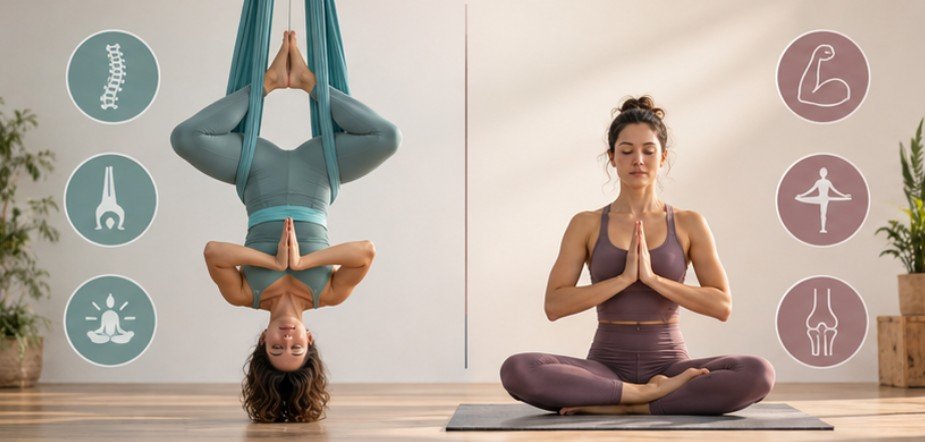
The biggest difference between aerial yoga vs regular yoga is not that one happens in the air. It is that a fabric hammock changes where your body gets support, how you manage balance, and how gravity acts on a pose.
Traditional yoga asks you to create stability against the floor. Aerial yoga introduces a moving support system that can carry part of your body weight, assist certain stretches, and make supported inversions more accessible.
Neither approach is automatically harder, easier, or more effective. The better fit depends on what you want from your practice, your experience, and how comfortable you are with instability and inversion.
What Regular Yoga Already Does Well
Regular mat-based yoga covers a surprisingly broad range of physical demands. Depending on the style, a class may combine mobility, isometric strength, balance, controlled breathing, relaxation, and sustained concentration.
The National Center for Complementary and Integrative Health reports that yoga research suggests benefits for general wellness, stress management, sleep, balance, and certain pain conditions. U.S. participation has also grown considerably: 15.8% of American adults reported practicing yoga in 2022, compared with 5% in 2002.
For readers wanting the federal research overview, see the NCCIH guide to yoga effectiveness and safety.
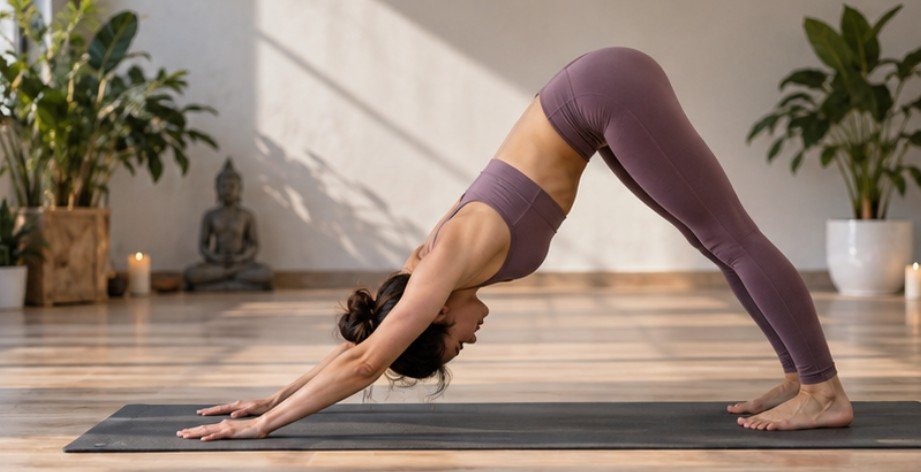
Mat yoga also provides something aerial practice cannot duplicate exactly: direct feedback from the ground. In Tree Pose, Warrior III, Plank, or Downward-Facing Dog, your hands and feet must create stable pressure while your muscles manage the rest.
Johns Hopkins Medicine notes that yoga can improve strength, balance, and flexibility when practiced consistently. You can read its practical overview at yoga benefits guide.
What the Hammock Changes in Aerial Yoga
Aerial yoga combines familiar yoga-inspired positions with a wide fabric sling suspended from secure overhead rigging.
That hammock can work in several ways. Because the hammock comes into direct contact with the body during different movements, knowing what to wear to aerial yoga can also make supported poses and transitions more comfortable.
It may support the pelvis during an inversion, take part of your weight during a standing position, provide leverage during stretching, or create instability that your trunk muscles must continually manage.
This changes the mechanics rather than simply making traditional poses more dramatic.
Pressure Can Shift Away From the Floor
A mat pose such as Tabletop or Downward-Facing Dog transfers considerable load through the hands, wrists, knees, and feet.
In some aerial variations, the hammock carries part of that load. Someone may therefore find particular supported movements more comfortable.
That does not mean aerial yoga is universally gentler on joints. The fabric itself can create concentrated pressure around the hips, thighs, back, or underarms, and poorly controlled transitions can still cause discomfort.
Balance Becomes Less Predictable
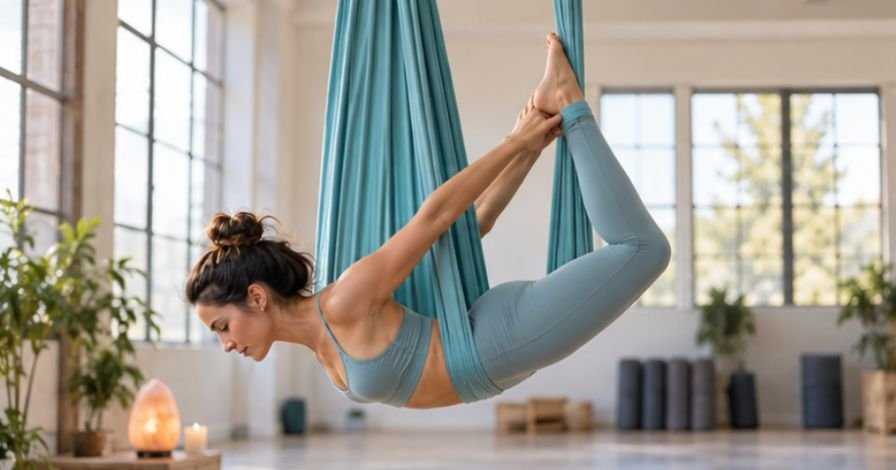
Standing on the floor gives you a fixed base. A hammock moves.
Even a small swing forces your nervous system and muscles to continually make corrections. That can make apparently simple positions surprisingly demanding through the abdomen, hips, shoulders, and back.
Regular yoga develops balance by asking you to stabilize against a predictable surface. Aerial yoga adds instability to the equation.
For a closer comparison of how this instability affects the trunk, aerial yoga vs TRX for core stability shows how the hammock and suspension straps create different demands on balance and core control.
Stretching Feels Different
The sling can support part of your weight while gravity assists a position.
For a more focused look at using the hammock for flexibility work, aerial yoga poses for tight hamstrings can provide examples of supported stretches that complement this approach.
This may allow some practitioners to explore ranges of motion that feel difficult on the floor. But “deeper” should not become the goal.
Flexibility varies enormously between people, and reaching farther does not automatically mean a better stretch. The University of Rochester Medical Center emphasizes that yoga can improve flexibility, strength, stability, posture, and body awareness while reminding beginners that practices can be modified around individual ability. Its overview is available through the University of Rochester yoga resource.
Aerial Yoga vs Regular Yoga at a Glance
| Factor | Aerial yoga | Regular yoga |
| Main support | Suspended fabric plus body | Floor, mat, and optional props |
| Balance challenge | Moving and less predictable | Grounded and predictable |
| Inversions | Hammock can partially support body weight | Usually require more independent control |
| Strength emphasis | Core stabilization, pulling, gripping, control | Weight-bearing, postural endurance, balance |
| Stretching | Fabric can assist positions | Muscles and props control range |
| Equipment | Proper hammock and secure rigging required | Usually only a mat |
| Learning environment | Instructor-led classes strongly preferred | Classes or appropriately selected home practice |
Inversions Are the Most Noticeable Difference
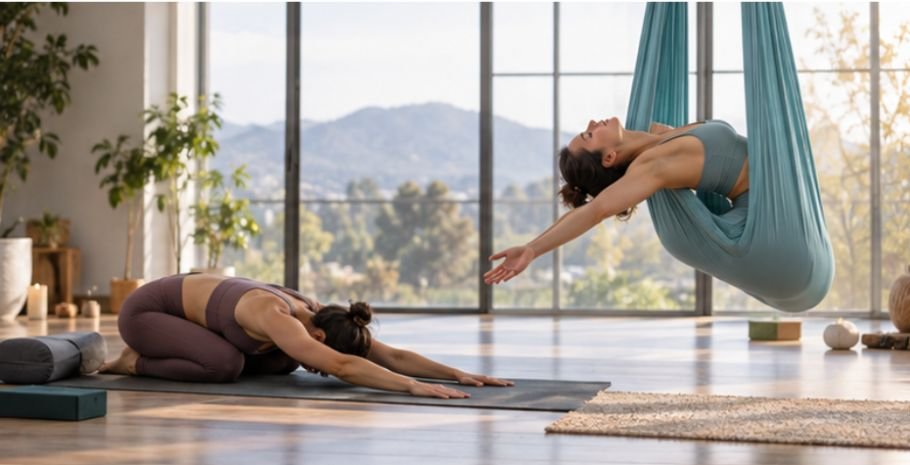
This is where the contrast becomes obvious.
A traditional Headstand, Forearm Stand, or Handstand can require considerable strength, balance, coordination, and technique. Beginners should not assume these poses are necessary for obtaining yoga’s benefits.
Aerial yoga can support inverted positions by placing fabric around the pelvis or other parts of the body. The practitioner may therefore experience being upside down without supporting the entire body through the hands, forearms, head, or shoulders.
However, a hammock does not make inversions risk-free.
The NCCIH advises yoga beginners to avoid extreme poses such as headstands and shoulder stands without suitable preparation and notes that people with conditions including severe high blood pressure, glaucoma, balance problems, or certain spinal issues may require modifications.
Anyone with medical concerns should discuss inversion-based exercise with an appropriate healthcare professional before participating.
What Does Research Actually Tell Us?
There is considerably more health research on conventional yoga than aerial yoga. That distinction matters.
For example, a meta-analysis of 18 randomized controlled trials found that yoga improved pain and disability compared with non-exercise interventions among people with chronic low-back pain, although findings varied by outcome and follow-up period.
That evidence should not simply be transferred to aerial yoga. Suspended practice changes loading, equipment, movement patterns, and inversion exposure.
MedlinePlus similarly describes yoga as an activity that may improve flexibility, posture, coordination, and relaxation while advising participants to start slowly, select an appropriate level, and avoid pushing through pain. See the MedlinePlus yoga safety and health overview for additional precautions.
The practical takeaway is simple: established research supports several benefits of yoga broadly, but claims that aerial yoga is scientifically proven to decompress the spine, improve flexibility faster, or produce superior health outcomes should be treated cautiously unless stronger direct evidence becomes available.
Common Misconceptions Worth Clearing Up
Aerial yoga is not automatically advanced. Beginner classes may use substantial hammock support and keep participants close to the floor.
Regular yoga is not automatically easy either. An athletic Vinyasa or Ashtanga class can be considerably more physically demanding than a gentle introductory aerial session.
Most importantly, neither system requires extreme flexibility. Mobility generally develops through appropriate, consistent practice rather than forcing the body into impressive-looking positions.
Can You Practice Both?
Absolutely. The two approaches can complement each other rather than compete. Mat sessions can develop grounded alignment and body awareness, while aerial sessions introduce a different balance challenge and new ways of interacting with familiar movements.
Someone practicing several times per week might therefore keep mat yoga as the foundation and occasionally add aerial classes for variety. Consistency matters more than choosing the trendier format.
Frequently Asked Questions
1. Is aerial yoga harder than regular yoga?
Not necessarily. Hammock support can make some movements easier, while instability, gripping, transitions, and suspended positions can make others more challenging.
2. Is aerial yoga good for complete beginners?
Beginner-specific classes can be appropriate for newcomers when taught by a qualified instructor using professionally installed equipment and gradual progressions.
3. Does aerial yoga improve flexibility faster?
The hammock can assist stretching, but strong evidence showing that aerial yoga produces faster flexibility gains than traditional yoga is currently limited.
4. Can aerial yoga replace normal yoga?
It can be your primary practice, but it provides different physical feedback. Mat yoga remains useful for developing grounded balance, alignment, and independent control.
Finding the Practice That Fits
The most useful way to think about aerial yoga vs regular yoga is not as a contest between the hammock and the mat. They change the same basic challenge—moving with awareness—by changing the support underneath you.
Regular yoga gives you a stable foundation and asks your body to create control from it. Aerial yoga deliberately makes that foundation less predictable while sometimes lending support where the floor cannot.
If you are curious, start with a beginner class rather than chasing inversions or deep stretches. Pay attention to how your body responds, choose instruction that prioritizes technique over spectacle, and let consistency—not height—determine how far your practice goes.


One thought on “Aerial Yoga vs Regular Yoga: What Actually Changes When You Leave the Mat?”