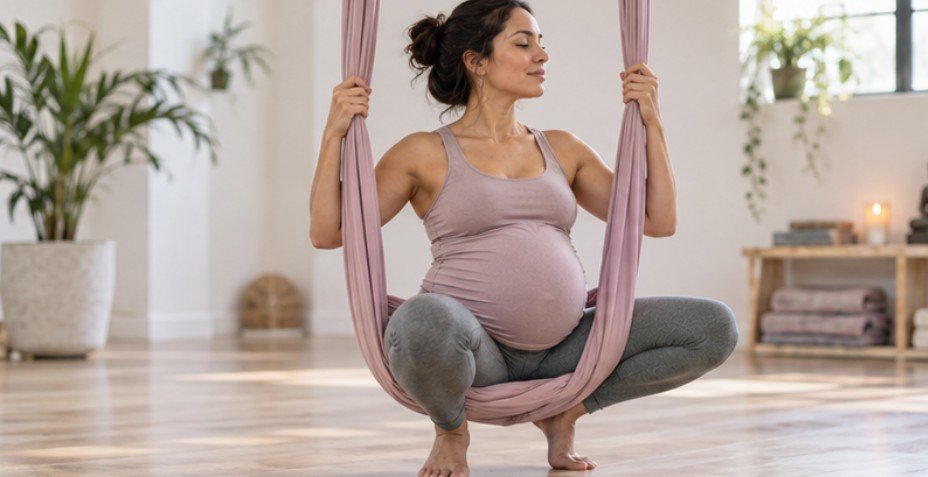
Pregnancy does not automatically mean giving up exercise. In fact, major U.S. health organizations encourage most healthy pregnant people to stay active. The complication with aerial yoga is not yoga itself—it is the height, instability, inversion, and fall potential created by the hammock.
So, can you do aerial yoga during pregnancy? If you are a beginner, pregnancy is generally not a good time to start. If you practiced aerial yoga regularly before becoming pregnant, heavily modified, low-to-the-ground movements may sometimes be possible after discussing the specific activity with your obstetric clinician.
The important distinction is that being cleared to exercise does not automatically mean every aerial skill is appropriate.
Why Aerial Yoga Requires Extra Caution During Pregnancy
Traditional prenatal yoga can be modified while keeping the body supported by the floor. Aerial yoga introduces suspended fabric, elevated positions, wraps, spinning, balancing, and sometimes inversions. That changes the risk equation.
The American College of Obstetricians and Gynecologists (ACOG) says people with healthy, uncomplicated pregnancies can usually continue regular physical activity. However, it recommends avoiding activities with a significant risk of falling. Pregnancy also changes balance and makes joints more mobile.
An aerial transition that was routine before pregnancy—stepping into fabric, rotating around the hammock or briefly taking both feet off the floor—can become less predictable as pregnancy progresses.
Pregnancy Changes Balance, Joints and Movement
Your center of gravity shifts
As the abdomen grows, weight moves forward and your center of gravity changes. ACOG notes that this can make pregnant people less stable and more likely to lose their balance.
That matters much more when you are suspended than when you are standing on a yoga mat.
The CDC recommends at least 150 minutes of moderate-intensity aerobic activity each week for healthy pregnant and postpartum women. Staying active is beneficial; the goal is choosing movement that does not add unnecessary injury risk.
Flexible does not necessarily mean stable
Pregnancy hormones make the ligaments supporting the joints more relaxed. This additional mobility can increase susceptibility to injury, particularly during forceful, jerky or extreme movements.
That creates a trap for experienced yogis: a deep stretch may still feel comfortable even though the joint supporting it is less stable.
Pregnancy is therefore not the ideal period to chase deeper splits, aggressive backbends or extreme hip opening.
Inversions introduce unanswered questions
Clinical research specifically examining aerial yoga inversions during pregnancy is extremely limited.
Previous experience may improve skill, but it does not eliminate pregnancy-related changes in balance, breathing, blood pressure responses or abdominal size. For that reason, removing inversions, drops, flips, swings and complicated transitions is a more conservative approach than relying on previous ability.
The Four-Question Aerial Yoga Pregnancy Test
Before returning to a hammock, ask these questions.
| Question | What the answer means |
| Did I regularly practice aerial yoga before pregnancy? | If not, choose a prenatal or ground-based activity instead. |
| Has my obstetric clinician discussed this specific activity with me? | If not, ask before continuing. |
| Can the session stay close to the floor without inversions, drops or belly compression? | If not, it is poorly suited to pregnancy. |
| Does the instructor understand prenatal modifications? | If not, choose another class or activity. |
One “no” should be enough to reconsider the session rather than trying to improvise modifications once class begins.
How Experienced Aerial Practitioners May Need to Modify Practice

If your obstetric clinician agrees that you can continue, pregnancy aerial practice should look substantially different from a standard class.
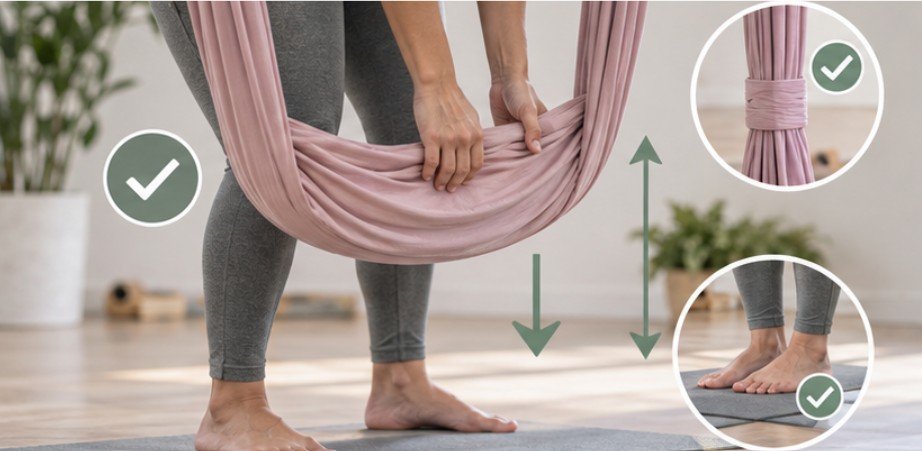
Keep the hammock close to the floor. Avoid skills where a slip could produce a significant fall. Skip drops, flips, rapid spins, swinging sequences and difficult transitions.
Fabric should not press tightly across the abdomen. Deep closed twists and intense abdominal exercises should also be reconsidered as the pregnancy progresses.
For a broader comparison of suspended core training, aerial yoga vs TRX for core stability can also help explain how different suspension-based practices challenge the core and balance.
Long periods lying flat on the back become another concern. U.S. health guidance recommends modifying or avoiding prolonged supine exercise later in pregnancy because the enlarged uterus can affect blood return to the heart.
Heat is also important. Hot yoga is not recommended during pregnancy because of overheating concerns, so aerial sessions should take place in a comfortably ventilated environment.
What Research Actually Says About Yoga During Pregnancy
There is encouraging evidence for yoga during pregnancy, but most of it concerns prenatal or modified ground-based yoga rather than aerial practice.
The National Center for Complementary and Integrative Health reports that a 2022 analysis covering 29 pregnancy-yoga studies and 2,217 participants found improvements in anxiety, depression, perceived stress and several labor-related outcomes. NCCIH nevertheless emphasizes that yoga may require pregnancy-specific modifications.
That distinction is important. Research showing benefits from prenatal yoga cannot automatically be used to prove that hanging upside down or performing suspended acrobatics is safe.
Why Prenatal Yoga Is Usually the Better Alternative
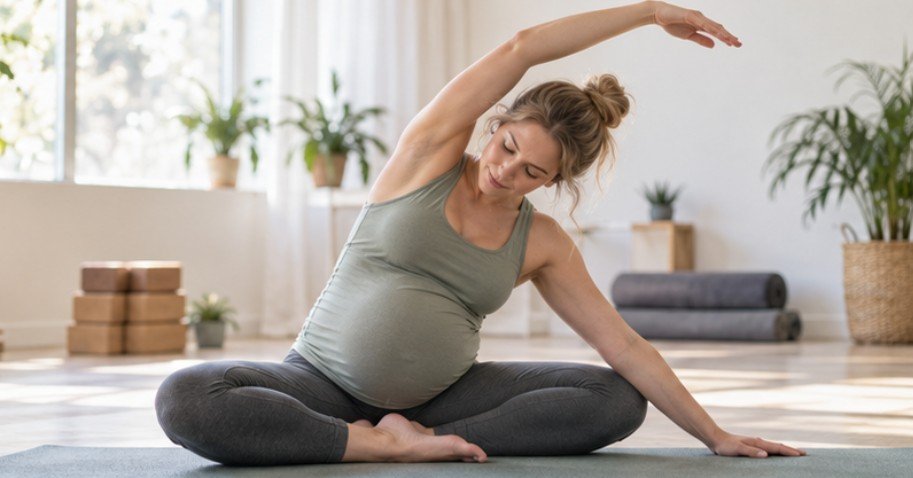
For someone asking can you do aerial yoga during pregnancy because they want stretching, relaxation or relief from stiffness, prenatal yoga may deliver much of what they are looking for without the suspended fall risk.
Modified prenatal yoga can support comfortable mobility, breathing, relaxation and gentle strength while allowing poses to change as the abdomen grows.
For beginners comparing different yoga and aerial options, understanding aerial yoga vs lyra hoop for beginners can also clarify how suspension, balance, strength, and apparatus demands differ.
March of Dimes includes modified yoga among activities that may be appropriate during healthy pregnancies while warning against activities involving movements that increase fall risk.
Walking, swimming, water exercise and stationary cycling are other options commonly recommended during pregnancy.
When You Should Stop Exercising
Even if you have been cleared to exercise, symptoms can change during pregnancy.
Because dizziness can also occur during aerial inversions, learning how to prevent dizziness during aerial yoga inversions can help explain why controlled transitions, steady breathing, and gradual position changes matter during aerial practice.
Stop the workout and contact your obstetric care team if you experience vaginal bleeding, fluid leakage, dizziness or fainting, chest pain, headache, painful regular contractions, calf pain or swelling, muscle weakness affecting balance, or unusual shortness of breath.
These are among ACOG’s warning signs for stopping exercise during pregnancy. Do not rely on an aerial instructor, online video or social-media post to evaluate these symptoms.
Frequently Asked Questions
1. Can beginners start aerial yoga while pregnant?
It is generally better not to. Pregnancy is not an ideal time to learn suspended balances, wraps and inversions. Prenatal yoga offers a lower-risk starting option.
2. Can you do aerial yoga during pregnancy if you practiced before?
Possibly, with individual medical guidance and substantial modifications. Practice should minimize fall risk and avoid inversions, drops, abdominal compression and difficult suspended transitions.
3. Are aerial yoga inversions safe during pregnancy?
There is insufficient clinical evidence to establish their safety. Because pregnancy affects balance and cardiovascular responses, avoiding suspended inversions is the more cautious choice.
4. Which type of yoga is preferable during pregnancy?
Prenatal or appropriately modified ground-based yoga generally has a stronger safety and research basis because movements can be adapted without adding suspension-related fall risk.
A Safer Way to Think About the Hammock
Pregnancy and physical activity usually belong together, but that does not mean every pre-pregnancy exercise should continue unchanged.
Aerial yoga introduces variables that ordinary prenatal yoga does not: height, instability, fabric pressure and suspended transitions. If you have never practiced before, save your first aerial class for after pregnancy and postpartum recovery. If you are experienced, discuss the exact practice—not simply “yoga”—with your obstetric clinician and expect significant modifications.
Maintaining movement is the goal. Maintaining every trick you could perform before pregnancy is not.