

If your elbows bend whenever you raise your arms, a wider grip may help more than a harder stretch. I like yoga strap exercises for shoulder mobility because the strap lets me adjust my reach without forcing my hands together. The goal is comfortable, controlled movement. A full overhead rotation is optional.
You need a non-stretch yoga strap, enough room to lift your arms, and a few minutes. You can stand or sit upright for most of this routine. Move slowly enough to notice what happens in your shoulders, ribs, and neck.
Set Up Your Strap and Check Your Starting Range
Hold the strap in front of you with your hands wider than your shoulders. Keep a little tension in it, but avoid pulling hard. Let your shoulders relax away from your ears.
Before starting, raise the strap only as high as you can without arching your lower back. Notice where you first feel the urge to lift your ribs, shrug, or bend your elbows. That is your starting range. Check it again after the routine. This gives you a more useful measure of progress than trying to bring your hands closer together.
A strap extends your reach; it does not make every position suitable for every shoulder. The American Academy of Orthopaedic Surgeons advises against exercising through pain. If you have an injury, recent surgery, or ongoing shoulder pain, ask a qualified clinician which movements fit your recovery plan.
Five Yoga Strap Stretches for Tight Shoulders
Use a gentle effort for each exercise. A mild stretch is enough. Keep your breathing steady, and shorten the movement whenever you start compensating with your neck or lower back.
1. Wide-Grip Overhead Pass
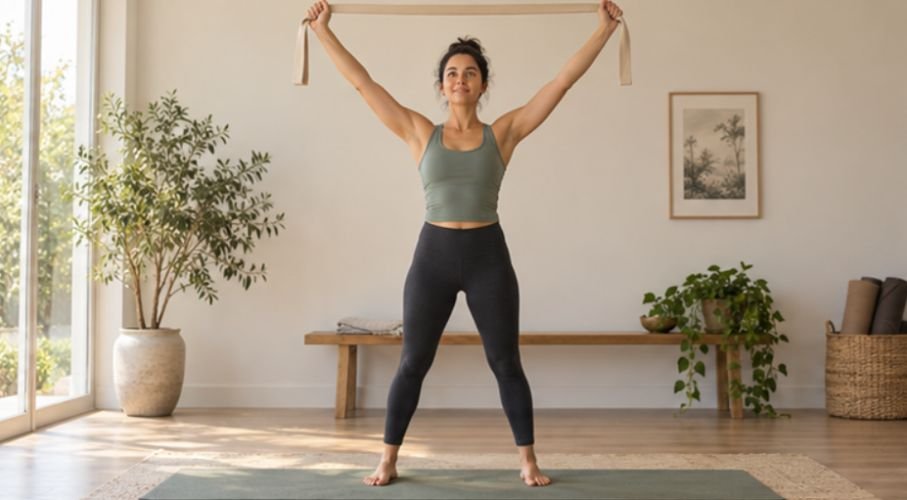
Hold the strap in front of your thighs with a very wide grip. Straighten your arms without locking your elbows. Slowly lift the strap toward the ceiling, then return it to the front. Try five controlled repetitions.
If that feels easy, explore moving your hands slightly behind your head. Only continue toward your back if the motion stays comfortable and your ribs remain steady. There is no need to reach your glutes. If your elbows bend or your shoulders pinch, widen your grip or stop at the top.
I treat the first repetition as a range check, not a target to beat. Each pass should feel at least as controlled as the last.
2. Cow Face Arms With a Strap

Drape the strap over your right shoulder. Reach your right arm up, bend its elbow, and hold the strap behind your upper back. Reach your left hand behind your waist to hold the other end.
Sit or stand tall. Gently move your hands toward each other until you feel a manageable stretch. Keep your head upright instead of pushing it forward to make room for your top arm. Hold for three to five easy breaths, then switch sides.
3. Overhead Side Bend
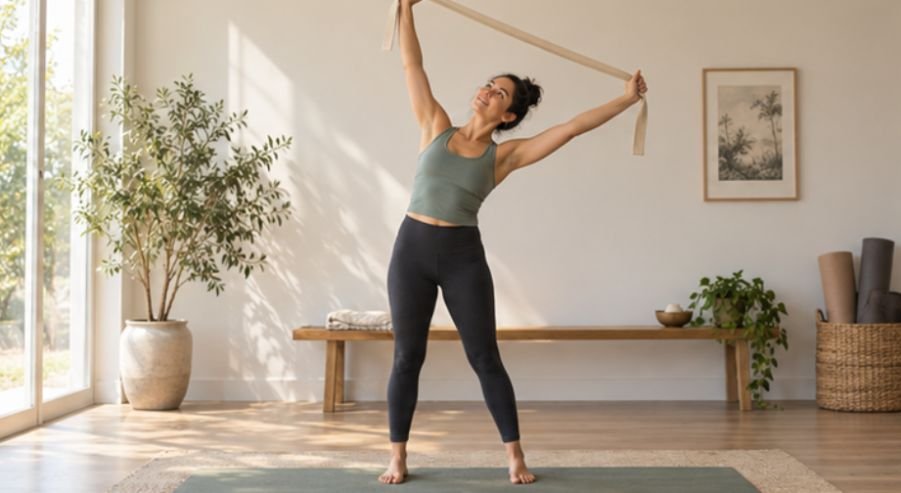
Take a wide grip and lift the strap as high as your shoulders comfortably allow. You can keep your elbows slightly bent. Lengthen through your spine, then lean a small distance to the right. Return to center and repeat to the left.
Keep your weight even across both feet, or both sit bones if seated. Let the bend come from your torso. Avoid pulling the lower arm down or twisting your chest sharply upward. Hold each side for about 15 to 20 seconds.
This move may create a gentle stretch along the ribs and outer shoulder. If lifting the strap overhead makes your neck tense, hold it at chest height and practice a smaller side bend.
4. Behind-the-Back Chest Opener

Hold the strap behind your hips with your hands wider than your shoulders. Let your palms face back. Stand tall and move your hands a small distance away from your body. Keep your collarbones broad and your ribs above your pelvis.
Pause for two or three breaths, then release. Repeat two or three times. You do not need to lift your hands high to feel a stretch across the front of your chest and shoulders.
Skip the forward-fold version if it pulls sharply at the front of either shoulder. The upright position makes it easier to control how far your arms move.
5. Gentle Goalpost Pull
Hold the strap overhead with a comfortably wide grip. Apply light outward tension. If your shoulders allow, bend your elbows and lower the strap a short distance toward the back of your head. Raise it again for five to eight slow repetitions.
Stop before your head moves forward or your ribs flare. If lowering behind your head feels awkward, bring the strap down in front of your face instead. Think of this as controlled shoulder and upper-back movement, not a test of how hard you can pull.
Shoulder mobility involves coordinated movement around the joint and shoulder blade. The American Council on Exercise describes mobility and stability as connected parts of shoulder function. That is why a smooth, modest range is more useful here than a dramatic stretch.
Build a Short Shoulder Mobility Routine
For a simple practice, do the overhead pass first, followed by cow face arms on both sides. Add the side bend and chest opener, then finish with the gentle goalpost pull. One round takes roughly five to eight minutes.
You can also practice how to do triangle pose without hyperextending knees to improve alignment and maintain comfortable control throughout the pose.
Keep the strap width consistent for a few sessions. If the movements become smoother, you may adjust your grip slightly. A narrower grip is not required for progress. Hugger Mugger’s strap guidance also explains how the prop can extend reach while supporting alignment.
Common Mistakes and When to Stop
The most common mistake is letting your lower back supply movement that your shoulders do not have. If your ribs push forward during an overhead reach, make the movement smaller. If your neck tightens, lower your arms and reset your grip.
Do not pull a strap against sharp pain, catching, or a pinching feeling inside the joint. A gentle muscle stretch is different from joint pain. Cleveland Clinic advises stopping yoga movements that do not feel right. Seek professional advice if pain persists or limits normal activities.
Frequently Asked Questions
1. How often should I use a yoga strap for shoulder mobility?
Start with a short, comfortable session a few times a week. Adjust the frequency based on how your shoulders feel afterward.
2. Should my arms stay straight during overhead strap rotations?
Keep a soft elbow rather than forcing it rigidly straight. Widen your grip or reduce the range if your elbows must bend to get past a tight spot.
3. Can I do yoga strap shoulder stretches while seated?
Yes. Sit upright with both feet supported, and avoid leaning back to move the strap farther.
4. Are yoga strap exercises for shoulder mobility safe with shoulder pain?
That depends on the cause of the pain. Avoid painful movements and get individual guidance if you have an injury or persistent symptoms.
Conclusion: Give Your Shoulders Room, Not a Challenge
I would rather finish a strap session with five easy, controlled reaches than one forced rotation. Start with a wide grip, choose two movements you can do without pain, and check whether your overhead reach feels smoother afterward. That small comparison tells you more than how far the strap traveled.