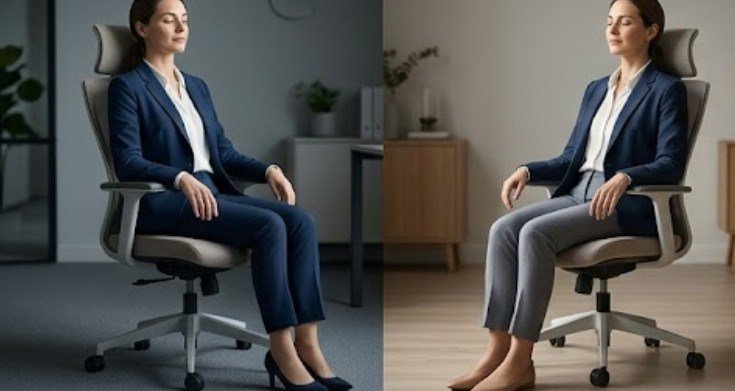
A hip stretch does not need to feel intense to be useful. In fact, pulling harder is not necessarily the fastest route to better mobility. Research on stretching suggests that consistent practice can improve joint range of motion, while greater intensity does not automatically produce better results.
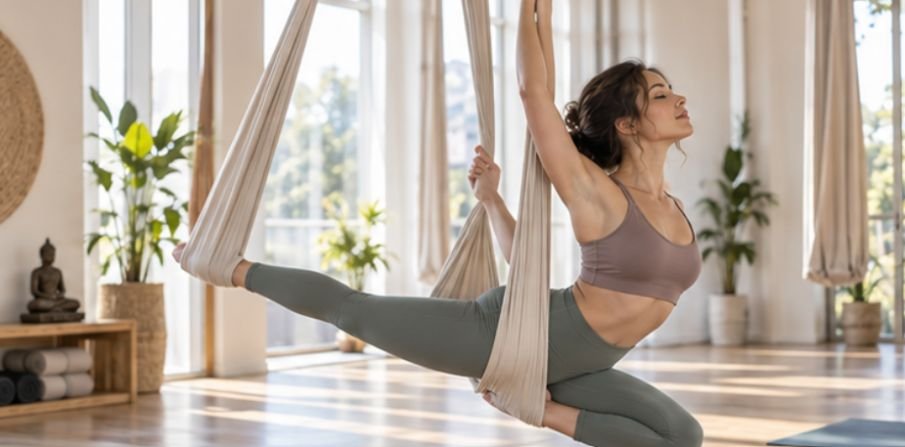
That is one reason aerial yoga for tight hips can feel different from conventional floor stretching. A suspended hammock partially supports your body weight, allowing you to explore hip movement without relying entirely on muscular effort or pushing aggressively against the floor.
For people whose hips feel restricted after long hours at a desk, workouts, driving, or repetitive movement, that support may make mobility work more comfortable and controllable.
Why Do Your Hips Feel Tight in the First Place?
“Tight hips” is a description, not a diagnosis.
The sensation can come from shortened or fatigued hip flexors, limited joint mobility, muscular tension, prolonged sitting, weakness around the pelvis, or simply being unaccustomed to a particular range of motion.
Hospital for Special Surgery notes that spending extended periods sitting can contribute to hip-flexor tightness and recommends regularly changing position rather than remaining seated for hours.
The hip is also more complicated than one tight muscle. Hip flexors cross the front of the joint, the adductors run along the inner thigh, gluteal muscles surround the back and sides, and deeper muscles help rotate and stabilize the femur.
That matters because repeatedly stretching only the front of the hip may not address what you actually feel.
What Makes Aerial Yoga Different From Floor Stretching?

The hammock acts almost like an adjustable yoga prop.
Instead of your hands, knees, or feet carrying your full weight, the fabric can support part of the pelvis, leg, or torso.
This difference is also explored in aerial yoga vs regular yoga, which compares how the hammock changes support, balance, and movement compared with traditional mat-based practice.
That changes how gravity acts on the body and may let you stay in a position without gripping as hard.
This is particularly useful during hip-opening movements where balance or knee discomfort prevents someone from relaxing on the floor.
There is an important distinction, however: although stretching and yoga have been researched extensively, high-quality clinical evidence specifically proving that aerial yoga treats tight hips is limited. Its potential advantages are based largely on the mechanics of supported movement combined with what researchers already know about stretching and yoga.
A 2023 systematic review involving 77 studies found that regular stretching produced meaningful improvements in joint range of motion. Static stretching and proprioceptive neuromuscular facilitation tended to produce larger long-term mobility gains than ballistic or dynamic stretching.
Four Aerial Movements That Target Different Areas of the Hips

The goal is not to force maximum flexibility. Think of the hammock as a way to find a tolerable position where your muscles can gradually stop resisting.
If you are new to aerial movement, aerial yoga vs lyra hoop for beginners can help you understand how the hammock-based practice differs from the strength, grip, and balance demands of a lyra hoop.
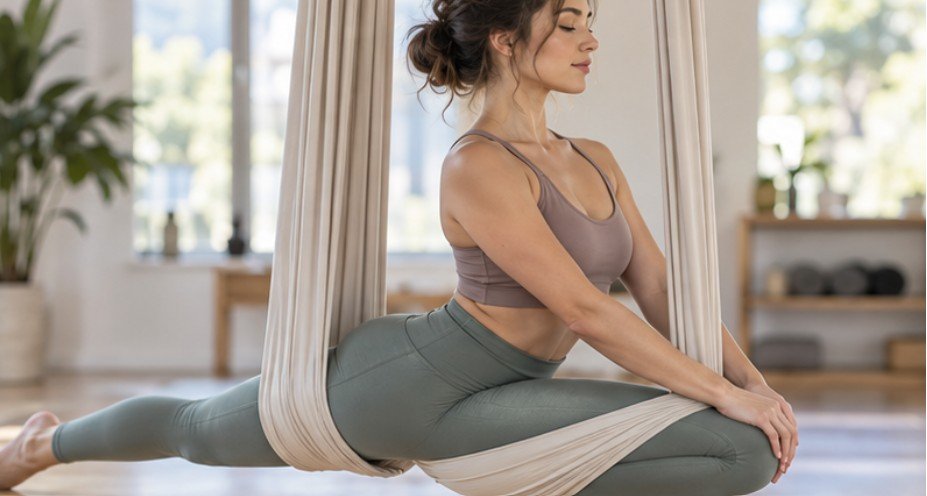
Hammock-Supported Pigeon
Traditional pigeon pose can place considerable pressure through the front leg and knee. An aerial variation can support the shin or thigh so less body weight bears directly through the pose.
You should primarily notice the stretch around the gluteal and outer-hip region. If you feel twisting or sharp pressure in the knee, change the angle immediately.
Supported Butterfly or Bound Angle
With the pelvis or torso securely supported, bringing the soles of the feet toward one another and allowing the knees to move outward targets the inner thighs and adductors.
There is no benefit to forcing the knees downward. Let gravity provide only the amount of opening that remains comfortable.
Floating Goddess
A wide stance with bent knees encourages hip abduction and external rotation. Using the hammock for support lets you experiment with gentle side-to-side movement while maintaining better control of your depth.
This can work well earlier in a session because the movement is active rather than a prolonged passive stretch.
Supported Hip Circles
Placing the hammock securely around the pelvis while keeping the feet grounded can make slow hip circles easier to explore.
Move clockwise and counterclockwise rather than repeatedly pushing into your stiffest direction. The purpose is to assess movement, not prove how large a circle you can make.
Use This Test Before Going Deeper
During any aerial hip stretch, ask yourself three questions.
Can I breathe normally? Can I keep the surrounding muscles reasonably relaxed? Does the sensation feel like broad muscular tension rather than pinching, burning, numbness, or sharp joint pain?
If all three answers are yes, the position is probably appropriate to explore gradually. If you are holding your breath, fighting the fabric, or experiencing joint pain, reduce the range. More flexibility is not automatically better.
Why Hip Strength Belongs in the Conversation
Someone can have flexible hips and still experience discomfort if the muscles controlling the pelvis are weak or poorly conditioned.
That is why mobility sessions can be paired with exercises such as bridges, controlled squats, clamshells, and other gluteal or core-strengthening movements. HSS specifically recommends strengthening the glutes, core, and surrounding muscles alongside hip-flexor mobility work.
Think of flexibility as gaining access to movement and strength as learning to control that movement.
When Tightness Should Not Simply Be Stretched
Persistent hip discomfort deserves more attention than another deep pose.
MedlinePlus notes that hip pain can result from problems including bursitis, strains, labral injuries, arthritis, impingement, and even conditions originating in the back.
Seek professional assessment if tightness is accompanied by significant groin pain, swelling, numbness, weakness, limping, pain after an injury, difficulty bearing weight, or persistent symptoms.
The National Center for Complementary and Integrative Health considers yoga generally safe for healthy people when performed appropriately but notes that strains and sprains can occur.
People with specific health considerations may also need to modify aerial practice, as discussed in can you do aerial yoga during pregnancy, where individual circumstances and appropriate modifications are important.
It recommends qualified instruction and modifications for people with existing hip or knee problems, balance issues, pregnancy, or other health conditions.
For aerial practice, instructor supervision matters even more because falls and improper hammock placement introduce risks that ordinary mat yoga does not.
Frequently Asked Questions
1. Is aerial yoga good for very tight hips?
It may help you explore hip stretches with additional body-weight support. Start gently, however, because intense stretching is not necessary for improving mobility.
2. How often should I do aerial yoga for tight hips?
Two or three mobility sessions weekly can be a practical starting point. Consistency matters more than forcing long or aggressive stretches during a single session.
3. Can aerial yoga help tight hip flexors?
Supported lunges, pelvic positioning, and hammock-assisted stretches may target the hip flexors. Strengthening and regularly changing position during the day are also important.
4. Should aerial hip stretches hurt?
No. Mild muscular tension is expected, but sharp pain, pinching, numbness, or joint pain is a reason to stop and modify the movement.
Give Your Hips Support, Not a Bigger Fight
The most useful thing about aerial yoga for tight hips may not be that it creates dramatically deeper stretches. It is that the hammock can remove some of the effort that normally keeps people from relaxing into controlled movement.
Use that assistance wisely. Warm up first, explore several directions of hip movement, stay below the point of pain, and combine mobility with strength instead of chasing maximum flexibility. If the hammock allows you to move more comfortably and consistently, that consistency—not gravity alone—is what is most likely to make your hips feel different over time.